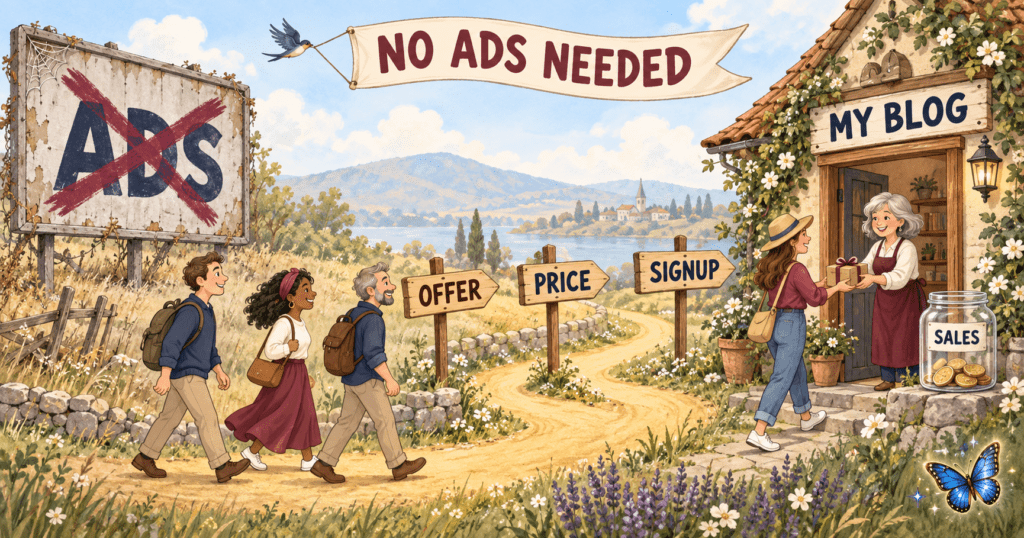
Most of the money advice for bloggers tells you to wait until the traffic shows up and an ad network finally lets you in. You can monetize a blog without ads, and you can start while your traffic is still small.
An ad pays you for every view, a fraction of a cent at a time, so it needs a crowd before it adds up to much. A sale pays you when one person says yes, and one person who trusts you is something a small blog already has.
This is the map I wish someone had handed me when I started blogging back in 2008. I wrote hundreds of posts across more subjects than I can count, and most of them never earned a thing, because very few were built to lead a reader toward something she could buy.
September took that map apart one piece at a time, and every post this month was one stop on it. This post puts the stops back in order so you can see how they connect, from the thing you sell to the moment she decides to buy it.
Why the Ad Route Makes a Small Blog Wait
Ad networks set a traffic floor before they will work with you. Raptive, one of the larger ones, asks for 25,000 pageviews a month before a site is even eligible.
A few smaller programs will take you sooner, but the math underneath stays the same. Ads turn attention into money slowly, and a blog with a few hundred visitors a month does not have much attention to turn yet.
An offer works on different math, and it starts with a small number. If one reader out of every hundred bought a $37 product, three hundred visitors in a month would bring in about $111, from a blog most ad networks would not look at twice.
There is a second cost people rarely mention. When a reader clicks an ad, she leaves your page for someone else’s, while an offer keeps her with you and gives you a reason to hear from her again.
That is why this whole month skipped ads. If you are still deciding whether a blog can really pay you at all, that question sits underneath everything that follows.
How much traffic do you need to monetize a blog?
Less than most people expect, as long as you skip ads. Ad networks want thousands of visitors a month because each view pays so little. An offer only needs a handful of readers who already trust you, which is why a blog with a few hundred monthly visitors can make its first sale before it ever qualifies for ads.
To Monetize a Blog Without Ads, Start With One Thing to Sell
The first stop is the one most of us skip. You cannot turn a reader into a buyer when there is nothing on the page for her to buy, and a list of ideas you might build someday does not count as something to buy.
When I wrote about choosing the one offer you sell first, the whole point was to stop splitting yourself across four ideas that never get finished. Four half built offers earn the same as no offer at all.
The offer that sells names one problem and finishes it. A reader who keeps landing on your posts about planning content does not need a program for her whole business when what she wants is the one thing that gets her planning done.
Once you know what you are selling, the price comes next, and the price decides more than your income. The price you charge is also your job description, because a buyer who hands over a thousand dollars expects your time, and a buyer who spends $37 expects a finished product.
Twenty seven sales at $37 come to $999, about the same as one high ticket sale, without a single call added to your calendar. Pick the price you could still deliver on if twenty people said yes in the same week, and for most women building around a full time job, that points to something small.
How do you monetize a blog without ads?
You sell one thing a single reader can say yes to. Pick an offer that solves the problem your readers already arrive with, price it low enough for a stranger to buy, and place it on the pages where your traffic lands. Ads pay for crowds, while an offer pays for one decision, which suits a small blog.
Your first offer is usually hiding inside your own story.
Send me day oneYour Own Product or Someone Else’s
There are two ways to have something to sell, and you do not have to pick only one. You can recommend products you already use, or you can make a small product of your own.
Recommending is the faster start. Nobody clicks a link that says click here, and the recommendations that earn come from something you use, with a line about why it earned a place in your day.
Keep the commission math in front of you before you build a whole post around a link. If a tool pays 30 percent on a $50 purchase, each sale earns you $15, and ten sales a month comes to $150, which only happens when readers trust the recommendation.
Neither one needs a big audience to start. A single recommendation inside a post that already gets steady visits can earn while your own offer is still being built.
Making your own takes longer, and it pays you in a different way. A small product of your own is something you keep current and keep selling, and the customer who buys it becomes yours instead of belonging to another company.
The part that surprised me is where the two meet. Your email list sits in front of an affiliate sale and your own product sale alike, and a link that passes through a page you control first pays you twice, once in the sale and again in the subscriber you keep.
How do you make money blogging without selling anything?
You recommend what you already use. An affiliate link pays you a commission when a reader buys through it, so you earn without building or delivering a product yourself. Send that reader through a page you own before the link, and you keep her email address even when the sale happens on someone else’s website.
Building the Road That Brings Her to Your Offer
A good offer sitting on a page nobody reaches still earns nothing, and that is where most plans to monetize a blog without ads fall apart. The next three stops are about the road in, and the road starts with the words she types into Google.
Some searches come from someone who is curious, and some come from someone who is ready to do something about it. A search like “what is a content plan” is usually curiosity, while “content plan template for bloggers” usually means she wants the thing now.
The second search names a format, and a reader asking for a format is already picturing herself using it. That is the kind of search a small blog can win and turn into a sale.
Writing a post built to sell, not just to rank, means choosing the search that already has a decision in it. The post still teaches, but the offer becomes the natural next step instead of something bolted on at the end.
Once she is on the page, your signup has to be where her eyes still are. In the post on where the money actually sits on a page, it all came down to one moment, right after the first section that gave her something she could use.
Give first, ask second, and ask while the giving is still fresh. A form at the very bottom of the page is waiting for a reader who, most of the time, already left.
The last stop on this road is the ask itself. Most people build pages to be read, not to convert, and the fix is often small: a real button, placed where she decides, with the right words sitting directly above it.
The sentence above your button does more work than the button does. Name the problem she just read about and hand her the fix, and you are welcome to borrow this line and change the details to fit your page:
“You just saw where readers are slipping away from your page. This is how you fix it without starting over.”
What is the best way to monetize a blog?
For a small blog, the best way is one clear offer with an email list in front of it. Search traffic rises and falls, but a subscriber stays, and every future sale reaches her through that list, whether it is your own product or a recommendation. Decide the offer first, then build the signup that leads to it.
Why This Order Matters More Than Any One Piece
You may have noticed the path runs from the offer outward instead of from the traffic inward. That is on purpose, because when you monetize a blog without ads, traffic only becomes money once it has somewhere to go.
Most of us build it the other way around. We chase readers first, then add a signup, then wonder what to sell, and by the time the offer exists, the posts that brought people in were never written to point anywhere.
It also changes how you judge a post. Instead of asking how many people read it, you ask whether the people who read it had a next step, and that question has an answer you can fix today.
When the offer comes first, every post after it has a job. The keyword you choose, the place your form sits, and the words above your button all start pulling in the same direction.
Before You Monetize a Blog Without Ads, Walk the Path Yourself
Once every stop is in place, the work changes from building to checking.
Readers rarely leave all at once. Most of them slip out at one particular spot, and that spot is usually easier to fix than you would guess.
The post on why you are getting leads and no sales walks through the six places that usually happens. Finding the one thing that stops the sale is a much smaller job than getting more people, and it is the job worth doing first.
I put this stop last because you cannot find a leak in a path that does not exist yet. Build the road first, then walk it the way a stranger would, from the search box to the checkout page.
Do This
Fill in the five blanks from your own blog. Leave a blank empty if you do not know the answer yet, then tap the button to see where your money stops.
Someone searching for
lands on my post about
signs up for
and buys
for $
Can you still make money with a blog in 2026?
Yes, and a small blog does not have to wait on ads to do it. Search still sends people to blogs every day, even as more quick questions get answered before anyone clicks. That makes every visitor who does arrive worth planning for, with one clear next step waiting on the page when she gets there.
What It Looks Like to Monetize a Blog Without Ads This Month
When you set out to monetize a blog without ads, the question for this month is not how to get more readers. It is whether the readers you already have can find something to say yes to.
You do not need all eight stops finished by Friday afternoon. Start with the stop the box above flagged for you, build that one piece, and move to the next one when it is done.
A small blog with one offer, one signup in the right spot, and one clear ask is already a business. The traffic can grow while it earns, instead of the earning waiting on the traffic.
You just saw the whole path, from the words she searches to the moment she buys.
The Content Map is how you plan the posts that carry her down that path, so each one leads somewhere instead of standing on its own.
Get the Content Map for $37Be unpolished,
Angela
The September money path, in order
1. Choosing the One Offer You Sell First
2. The Price You Charge Is Also Your Job Description
3. Nobody Clicks a Link That Says Click Here
4. Making Your Own Small Product Instead of Selling Everyone Else’s
5. Writing a Post Built to Sell, Not Just to Rank
6. Where the Money Actually Sits on a Page