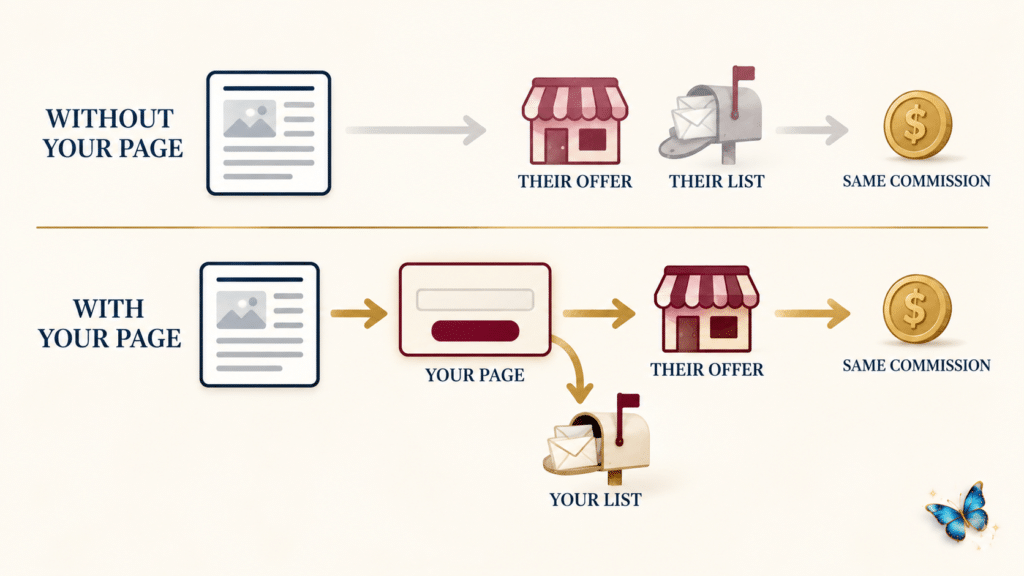
When you sell your own digital product, the difference is not really the money on that one sale, though the money is better. The difference is who ends up with the buyer. An affiliate sale hands your reader to somebody else’s list, and your own product puts her on yours.
Every comparison of these two on the internet argues about commission rates and profit margins, and that argument skips right past the part that decides whether you still have a business in two years. A commission is one payment that arrives and then it is over. A buyer is every payment that comes after it, but only if you kept her.
None of this is me telling you to take your affiliate links down. Mine are still up, and they are staying up. They just run through my list first.
What happens to your reader after she buys through your affiliate link?
She becomes their customer instead of yours. The company collects her email address, her card, and permission to sell to her for the next several years, while you collect a percentage of one transaction and a thank you page with their name on it.
I have affiliate links on my own site right now. When someone signs up for AWeber through my link, AWeber gets a customer and I get a commission, and that is a fair trade for a tool I use and would recommend anyway.
What I do not get, unless I built it on purpose, is her name. You found her, you convinced her, you answered the question that made her ready to buy, and then one click moved all of that into somebody else’s account.
How do you use an affiliate link without giving away the lead?
You put something you own in front of it. My affiliate links do not send anyone straight to the company. They go to a simple opt-in page I built, she joins my list there, and then she goes on to the offer, either by redirect or in the first email she gets from me.
The page does not have to be impressive. Mine are plain. The commission is exactly the same either way, and the difference is that now two things happened instead of one. They got a lead and so did I.
This is the step women skip because it feels like it stands between a reader and a sale. It is the only step that pays you twice, and it is worth building long before you sell your own digital product.
If you have not built your first one yet, I walked through what makes an opt-in worth signing up for, and simple is genuinely fine.
You cannot build an opt-in page until you know what you are offering.
Five days of email that help you find your own story, which is what gives your page a reason to exist and gives your affiliate links a place to sit.
Send me day oneDo you make more money when you sell your own digital product?
On that one sale, usually yes, because you keep the whole price instead of a slice of it. Thirty percent of a thirty seven dollar product comes to about eleven dollars, and the same product sold as your own comes to thirty seven less the processing fee.
The gap between eleven and thirty seven is not the interesting number though. The interesting number is the second thing she buys from you, and the third, which can only happen if her email address landed in your account.
That is also why the price of a first product matters less than people think, something I got into when I wrote about whether to start low ticket or high ticket. A thirty seven dollar sale that puts a buyer on your list is worth more to you than a hundred dollar commission that does not.
What should your first product be?
When you sell your own digital product for the first time, it should be the thing you already explain over and over, in a smaller form than you are picturing. Not your biggest idea and not the course you have been outlining since spring, but the question you have answered four separate times this month in a comment, a reply, or an email to someone who asked.
You keep answering it because people keep needing it, and you keep giving it away one message at a time because it never occurred to you that the answer was the product. It reads as ordinary to you because you know it well.
If you are still deciding what shape that takes, I went through the options in what to actually sell on your blog, and most women land somewhere much smaller than they expected to.
Do this
Open your own blog and find every affiliate link you have live. For each one, follow the click and ask where the reader’s email address ends up. If the answer is their account and not yours, that link is doing full price work for one payment. Pick the one that gets the most traffic and decide what would sit in front of it.
Can you still use affiliate links when you sell your own digital product?
Yes, and you should keep them. Once you have something of your own, affiliate links stop carrying your income and start doing a different job, which is pointing your buyer at the tools she needs to run the thing she just bought from you.
That takes the pressure off the link, and it is most of what I meant when I wrote about affiliate links that stop pretending they are not sales. A link recommending the email tool she now needs reads as help, because it is.
Wherever those links sit, they still have to be labeled as what they are. The FTC endorsement guides ask for the disclosure to sit close to the link itself, not buried on a policy page nobody opens.
What happens when other people sell your own digital product?
The direction reverses. Instead of you sending buyers to someone else’s list, other people send buyers to yours, and you pay for that out of the sale price rather than out of your time.
I run an affiliate program for the Content Map, and anyone who buys it can sell it. Two or three sales puts her thirty seven dollars back in her pocket, which is a reasonable trade for both of us.
When one of those sales comes through, the buyer lands on my list. It is the same transaction as the AWeber one at the top of this post, with me standing on the other side of it, and that is the whole difference between selling somebody else’s work and selling your own.
The reason to sell your own digital product is not that affiliate income is bad money. It is that a commission ends and a reader does not have to, and the question of whether a blog can really pay you usually comes down to which of those two you have been collecting.
If you want the plan for what to publish so a product like that has somewhere to sell from, along with how to route your affiliate links through your own list first, that is what the Content Map is for.
Be unpolished, Angela