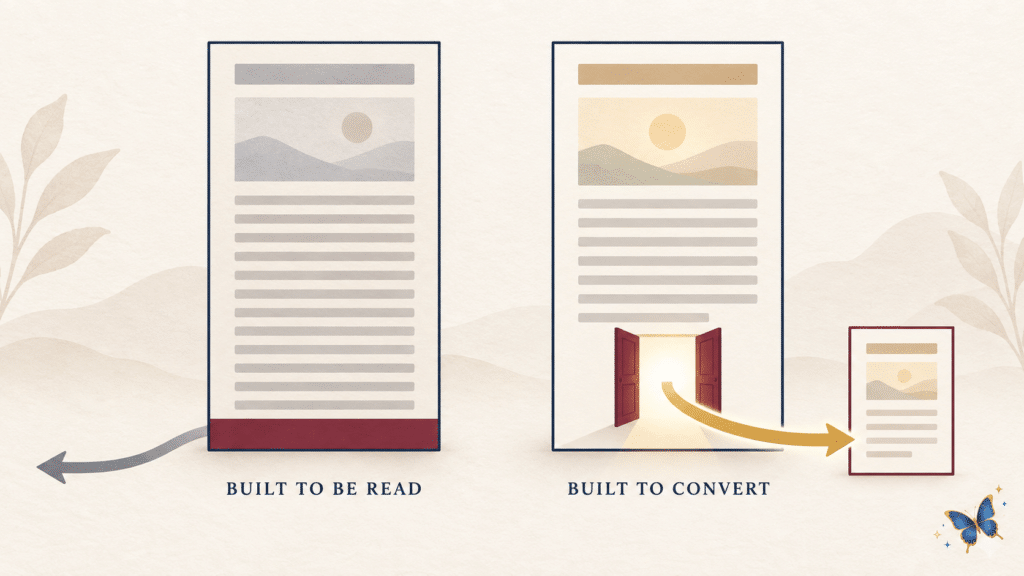
You can write a genuinely useful post, rank it on Google, and collect traffic for years while making almost nothing from it. A blog post that converts is not a better written version of that page. It was built differently from the title down, to move her somewhere rather than to inform her and let her go.
The page works exactly as designed. The design was the problem.
Almost nobody builds them the other way. You sit down with a question you know how to answer, you answer it thoroughly, and every choice you make along the way is about helping her understand. None of them are about helping her move.
What separates a page built to be read from a blog post that converts?
The goal you had in your head while you wrote it, which shows up in every decision underneath.
Both pages have to inform her, or neither one earns the visit in the first place. What changes is what the information is pointed at. One version is finished when she understands. The other is finished when she can see her own next move.
You cannot patch that at the end. The ending is the last place it shows up, not the place it went wrong.
Does your title promise information or a result?
Open your best performing post and read only the headline.
Most titles describe contents. What email marketing is, ten ways to grow your traffic, a guide to something. That is a table of contents promise, and the woman who clicks it came to know a thing. She knows it now. The transaction is complete.
The title is also carrying more weight than you think. Nielsen Norman Group has been running eye-tracking studies on this since the nineties, and the finding barely moves. Most people scan a page rather than read it, and only about one in six reads word for word.
The title on a blog post that converts promises her a different situation on the other side. She does not arrive as a student, she arrives as somebody trying to fix something, and a page that treats her like a student for nine hundred words will not talk her into moving at the bottom.
Your writing may not be the problem. The page may be.
Five days of email that help you find the thread your work is already built on, which is what tells you where each page should have been leading in the first place.
Send me day oneWhy does a blog post that converts feel different in the middle?
Because it is going somewhere, and a page built to be read is covering everything.
Comprehensive feels responsible. You know this subject, you can see all the angles, and leaving one out feels careless. So you put them in, and what she gets is a complete picture of a topic instead of a path through her own situation.
A blog post that converts is narrower than you want it to be. It takes one woman in one position and walks her forward, leaving out four things you know because those four belong to a different woman. That narrowing feels like a loss while you are writing. It is the whole reason the page works.
Where does the ask come from in a blog post that converts?
From the post itself. The ask should be the next thing you would say if the page kept going, and you can feel the difference when it was added afterward instead.
You write eight hundred words about one specific topic, then invite her to join a newsletter about something general, and the seam between those two shows even when she could not name it. She came with a particular problem and got handed a generic offer, so she treats it the way she treats every other generic offer. It is the same seam I wrote about in affiliate links that stop pretending they are not sales, arriving from a different direction.
When the page was built to convert, the ask is the sentence the whole post was walking toward. She has just understood why her pages do not move anybody. The next question in her head is what to do about her own, and the ask answers that exact question. Nothing about it feels like a swerve, because it is not one.
Do this
Open the post you would send somebody to if they asked what you do, and read two things, the title and the final paragraph. Then say out loud what that page wants her to do when she finishes. If you cannot say it in one plain sentence, or if the answer is that she learned something, the page was built to be read.
What does your last paragraph do to her?
It usually ties everything off, which is the most natural thing in the world to write and the worst thing you can do to her at that moment.
A summary closes the loop. She reaches the end with nothing unresolved, no itch, no reason to stay, and she leaves satisfied. Satisfaction looks like success and it is the quietest way a page fails.
What a blog post that converts does instead is name the gap her new understanding just created. She knows what is wrong now and cannot see it in her own work. She agrees with the principle and has forty posts and no idea which one to touch first. That gap is real, you did not manufacture it, and saying it out loud is what makes the next step read as help.
What does a page built only to be read cost you?
It keeps costing, quietly, for as long as it stays up.
That post will bring women in for years. Every one of them arrives, takes what she came for, and leaves without you ever knowing she was there. You paid for the page once in writing hours, and you pay again every month it works, because working is all it does, and whether a blog can really pay you comes down to how many pages like that you are carrying.
I went through my own blog and pulled down more than two hundred posts. Most of them were fine. They were also telling Google that this site was about a little of everything, and every one of them was a page somebody could land on and leave from without ever finding a next step. I would rather have fewer pages that know what they are for.
Start with the three or four posts you already know bring people in. For each one, decide the single thing it should produce, whether that is a subscriber, a reply, or a sale of something of your own, then connect it to the post that answers the question it leaves her with, so she has somewhere to go besides away.
That is what the Content Map is for.
If this one helped, the share buttons at the bottom will pass it to a woman who needs it.
Be unpolished, Angela