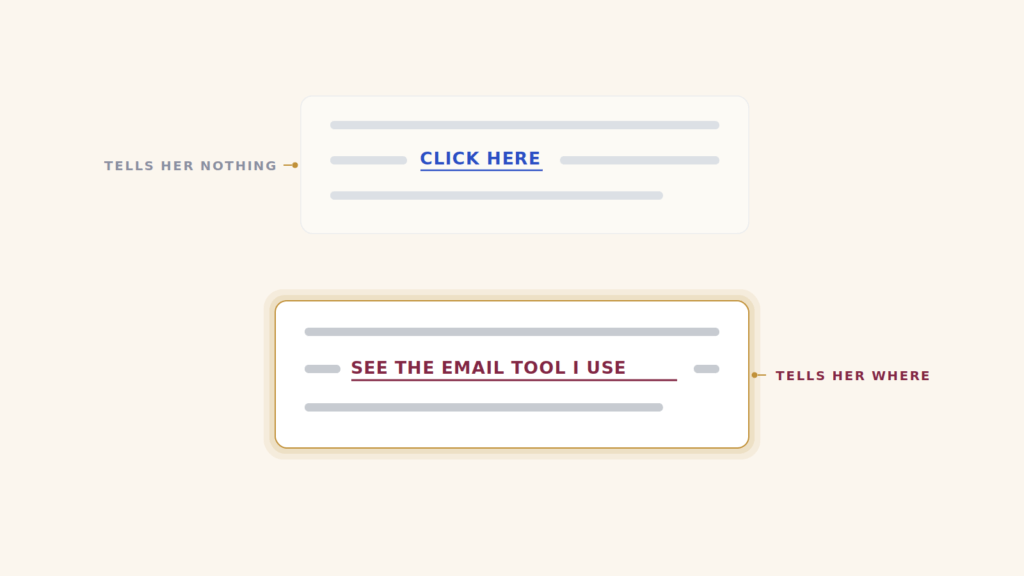
Salesy affiliate links come from one habit, which is hiding what is behind the link instead of telling her before she clicks it. Nobody clicks a link that says click here, because she has no idea what she is agreeing to look at.
The strange part is that trying not to sound salesy is what turns people sleazy. You soften the recommendation until it says nothing, you slide the link in without explaining it, and you avoid mentioning that you earn from it.
All of that is less straightforward than saying outright that this is the tool you use and you get paid when somebody signs up through you.
What makes salesy affiliate links sound that way?
The words carrying the link are doing urgency instead of information. Click here, look now, last chance, and the reader has no reason to click except pressure.
I did it that way for a long time because I thought that was how it was done. Almost nobody clicked those links, and at the beginning I did not even know how to check whether anybody was looking at my stuff at all.
Those phrases turn into noise. After a while you stop paying them any attention, and I noticed that in myself first as a reader before I ever noticed it in my own posts.
How do you fix salesy affiliate links?
With a full sentence that tells her where she is going and what she will find when she gets there. Salesy affiliate links are three highlighted words carrying nothing, and the sentence is what replaces them.
Everybody already knows a link goes somewhere, to a page or an opt-in or another post. That part is not a mystery to anybody.
What she does not know is whether it goes to the next answer to the question she was reading about, or to somebody trying to sell her something she never asked for.
The sentence around the link is what tells her which one it is. She clicks knowing, and nothing on the other side is a surprise.
Want help finding your story?
You cannot write a recommendation that sounds like you until you can hear your own voice on the page. The Three-Day Mirror walks you through finding that language in your own story.
Help me find my storyDo you have to tell people you earn from a link?
Yes, and it costs you far less than hiding it does. She assumes there is money involved anyway, because she has been reading online long enough to know how this works.
Everybody feels like every step you take, somebody is trying to hold not your hand but your Visa card instead of answering the question you came in with. Pretending there is no money behind the link is the part that insults her.
Saying it outright takes one clause and it removes the thing she was suspicious about. Then the recommendation gets judged on whether it is any good, which is where you want it judged.
When you stop trying to be sneaky about it, you build a connection faster than any amount of pretending would have got you. She already knows you are in business and that you have something for sale.
Sales is not slimy. It is how you make money, and there is nothing to apologize for in saying so out loud.
What happens when a link does not explain itself?
You do not lose her from the page you sent her to. You lose her from your blog.
She clicks a bare blue link, lands somewhere trying to sell her something she was not looking for, and she closes the tab. She does not come back and finish reading your post.
That is the part nobody counts. A vague link does not cost you a click, it costs you the reader, and she was reading something of yours right up until you sent her somewhere she did not agree to go.
Tell her what is behind the curtain and the ones who want it click, and the ones who do not keep reading you. You keep her either way.
Should you only recommend things you use yourself?
It is the only version I know how to write without it reading as an advertisement. If you have not used it, there is nothing specific to say about it, so you end up borrowing the words off the sales page.
I send beginners to AWeber because it is easy when you are starting and it grows with you until you need something more. That is an affiliate link and I earn if you sign up through it.
I also use GoHighLevel, and it is for somebody who needs more in her ecosystem and is willing to learn to manage it or has somebody to manage it for her. I learned it on my own.
I started on AWeber myself and stayed almost ten years. I moved to GoHighLevel because I wanted to build funnels and keep everything on one platform instead of paying for several.
Before that switch I was spending nine hundred dollars a month on tools to run this business. That is the difference between those two recommendations, and it has nothing to do with which one is better.
What if the better tool is not the one paying you?
You say so, and you send her to the right one anyway. The moment you point a beginner at the bigger tool because it pays more, she finds out, and everything else you have written goes with it.
A recommendation worth reading includes who it is wrong for. AWeber is not the answer for somebody running a whole ecosystem, and GoHighLevel is a lot to take on when all you need is a signup form and a weekly email.
Saying that out loud costs me a few signups and it is the reason the recommendations are worth anything at all.
How many affiliate links is too many in one post?
The count matters less than whether each one earns its sentence. Salesy affiliate links are not a volume problem, they are a wording problem.
I followed somebody whose newsletter appeared three times in a single post, and I signed up anyway, because each mention told me something different about what I would get.
I have also read posts where the same link showed up twice and it already felt like being handled. The difference was never the count.
When the mentions turn into noise you scroll past them without reading, and at that point you have lost her whether there were two or six.
Why does she need to learn something from you first?
Because the recommendation means nothing until she believes you. She has no way to judge whether the tool is any good, so what she is judging instead is whether you are worth listening to.
A link is you saying trust me on this one. If she has not got anything from you yet, you are a stranger asking for a favor.
That is why the recommendation goes after you have solved something for her, not in the first breath. Give her the answer first and the link becomes the obvious next step instead of the price of admission.
It also means you have to be right about the thing. If she takes your word for it and the tool turns out wrong for her, you do not get asked twice.
Why are salesy affiliate links less of a problem on a blog?
Because you have room for the sentence. On social you get one link in a bio or dropped in a comment, with no space to say what is on the other side of it.
In a post you can write a whole line explaining what she is about to look at and why she would want it. That line is where the trust gets built or lost, and it is the one advantage blogging has that nobody talks about.
If you are working out what to sell and recommend in the first place, the Content Map walks through that for thirty seven dollars.
What she wanted all along
Nobody wants to be sold to. She wants information that backs up what she is already reading, and a link that takes her to the next answer rather than a pitch.
I got tired of being sold to in everything I read. We all know there is a money plot behind most of it, and knowing that is fine, because I wanted to learn something from the person first before I clicked anything.
Answer her question well enough that she trusts what you are saying is true, and write about the problems she came in with.
Do that and the link at the end is not a pitch anymore. It is the next thing she needed, and salesy affiliate links stop being something you have to worry about.
Do This
Open your own most recent post with a link in it and read only the words the link is sitting on. If it says click here, read more, or the name of a product with nothing around it, she has no idea what she is agreeing to look at.
Rewrite that one line into a sentence that says where she is going and what she will find. Change nothing else on the page, and watch whether that link starts getting clicked.
Be unpolished, Angela