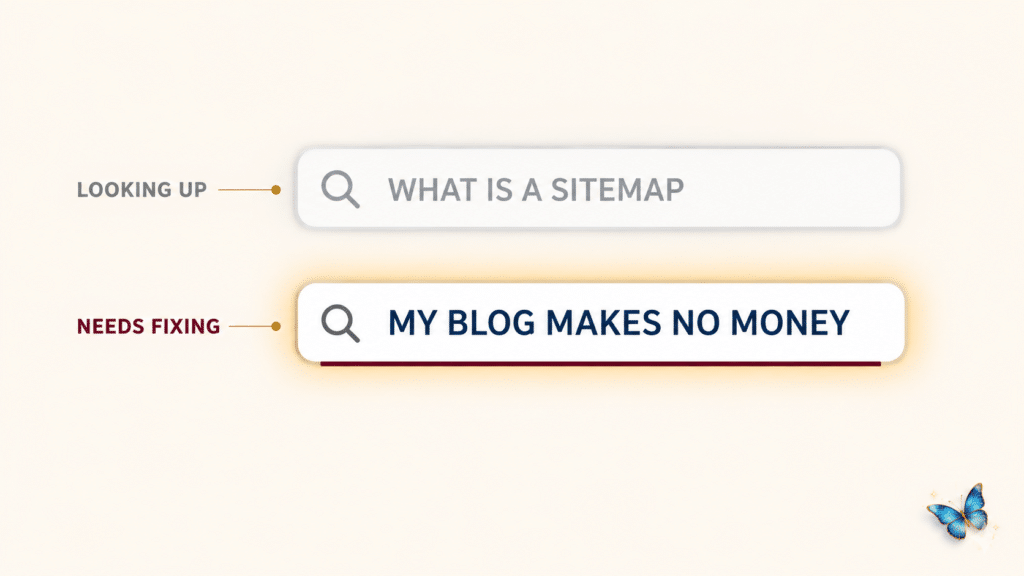
Keywords that convert come from a woman with a problem she is trying to solve, not a woman looking up a definition. She may be nowhere near paying anybody yet, and that is fine, because your job on that page is to show her that what you have is what fixes it.
Most posts are built on the other kind of keyword. You can have a post that ranks, brings people in every week, and has never made you a single dollar.
There is nothing wrong with that post. The topic never brought you anybody who wanted to buy something.
Seventeen years in, the thing I run into most is a good post that was never going to sell anything. The topic was picked for traffic, and traffic was what it delivered.
Why does my blog get traffic but no sales?
Usually because the posts bringing the traffic are answering questions that have nothing to do with buying. A woman looking up what a sitemap is has no plans to hire anybody that afternoon, and no button is going to change her mind.
I wrote plenty of those posts myself. Somebody would land on one, get exactly what she came for, and that was the end of it.
It took me a long while to work out how to turn the women who came looking for information into women who bought something. The fix was never inside the post.
The standard advice makes it worse. It tells you not to be salesy, give value, and they will remember you later, so you write another helpful post on another topic nobody buys from and wait.
If your traffic is arriving and the money is leaking somewhere further down, that is a different problem and I wrote about where the leak usually sits. What I am talking about here is the kind that could never have sold anything.
Both columns sit in the same topic. Only one of them came from a woman with something to solve.
What makes keywords that convert different from the rest?
Keywords that convert come from somebody with a problem in front of her right now. She is not necessarily ready to buy, she is researching, and that is exactly who you want.
The test is whether there is a real problem behind the search, not whether her card is already out. Search volume has almost nothing to do with either.
This is the part that gets left out when people teach keyword research. The common mistake is going after the phrases with the biggest numbers when nobody typing them has a problem, then trying to rescue the post afterwards with pop-ups and buttons.
Want help finding your story?
You cannot pick the keyword a buyer types until you can say her problem in her own words. The Three-Day Mirror walks you through finding that language in your own story.
Help me find my storyHow do you find keywords that convert?
They are already in your own social posts and your inbox. People tell you what they are looking for, what they are struggling with, and what they want fixed, and those sentences are keywords before anybody puts them in a tool.
I have listened to a lot of trainers over the years hand you a keyword tool and teach you how to dig for what people are searching. The tool is fine and it comes second.
The words come first, and they come from the women already talking to you. Go and read the last month of comments on your posts and the replies to your emails.
The phrases that keep coming back are what she would type into Google, in her words rather than the tidy version a tool hands you.
Small numbers beat big ones here, and I know that is the opposite of what everybody wants. A phrase with two hundred searches from women who have the exact problem you solve is worth more than one with twenty thousand from people who are curious.
The big number looks better on a screen. The small one brings you somebody you can help.
None of this means going into deep research mode before you are allowed to write anything. Find a keyword, find your topic, write around it and stay on it.
That is the whole job. The research is one decision at the start, not a project you have to finish before you can open a blank page.
Can a call to action rescue a post built on the wrong keyword?
No. A call to action can only work with the reader the keyword brought you, and if she came for a definition there is nothing for it to work on.
This is why so many women conclude their offer is wrong or their writing is weak. Neither is usually true.
The post was answering a question that had no problem behind it, and no amount of rewriting turns a curious reader into a woman who needed something fixed.
Google Search Console is where I go for this. It is a no cost Google tool that lists the actual phrases people typed before they landed on your site.
It shows me the words people used to find me rather than the words I assumed they used, and those two are almost never the same.
It matters where the ask sits on the page too, which is why I moved my own opt-in up out of the footer, but that is its own conversation and I had it on Monday. The keyword decides whether there is anything worth asking for in the first place.
The exception is a post that already sits close to a buying decision and never asked for anything.
Those are worth going back to, and they are usually easy to spot, because you already know which posts bring you email replies from people asking what you charge.
Should every post be written to sell something?
No, not necessarily. A post can answer one question and hand her to another post of yours that answers the next one.
That is what you are building, a web of information where one post connects to another, rather than a pile of posts each sitting on its own. What every post needs is a job you chose on purpose.
Some posts exist to bring strangers in and hand them to a better post. Others exist to answer the question sitting directly in front of your offer.
Trouble starts when you have twenty of the first kind and none of the second, which is the shape most blogs are in.
Go back over your last ten posts and ask how many were written for a woman with a problem. If the answer is none, that is your finding, and it explains a quiet month better than any theory about the algorithm.
How do you pick topics that lead to your offer?
Keywords that convert sit next to a problem she can already name. Pick the thing she is trying to fix, not the thing she is still working out the word for.
Most people write the still-working-it-out post, because it is more comfortable and it brings more traffic. The post sitting right on top of her problem feels too narrow and too close to selling, so it never gets written.
That narrow post is the one that pays. It reaches fewer people and it reaches them while they are looking for the thing you already sell, and knowing which single thing you sell first is what makes that topic obvious.
Is high traffic worth anything if nobody buys?
It is worth something, though a lot less than it feels worth. Traffic that never buys still tells Google what your site is about, and other people still link to posts like that.
What it does not do is pay you, and a blog that runs on it alone will feel like it is working right up until the point you look at your bank account.
The number worth watching is not visitors. It is how many of your posts she could have found on the day she went looking for a fix, and whether she could see your ask once she got there.
Your own keywords that convert are already in your data
Search Console is already recording every phrase people typed before they landed on you, so none of this needs guessing at. The queries bringing you clicks are sitting there in the words your readers used.
Read the top ten and sort them into two piles. Questions someone asks while learning, and questions someone asks while deciding.
If the deciding pile is empty, you have found the reason a good blog is producing a quiet month. If you want the order and the plan rather than working it out post by post, the Content Map lays that out for thirty seven dollars.
Do your old posts already have keywords that convert?
Look at what is already ranking before you write anything new. Search Console will show you which of your posts people are finding, and some of them are already bringing in women with a problem.
Those are the ones worth your time first. The post exists, Google already trusts it, and it sits closer to paying you than anything you have not written yet.
Read what she typed to get there, then read your own post and ask whether it gives her anywhere to go once she has her answer. Most of the time it does not.
Change one thing and leave the rest of the post where it is. If you rewrite a post that is already ranking you can lose whatever earned that ranking, and you will never know which change did it.
Leave your other posts alone. One that brings in curious readers is doing its job.
The post you write next
One post written for a woman with a problem will do more for you than four more written for somebody looking up a definition. The difference has nothing to do with how well you write and everything to do with who is reading it.
She is already telling you what she is struggling with. Go and find the sentence she keeps saying, then write the post that shows her what you have is the thing that fixes it.
Do This
Open Google Search Console, go to Performance, set the range to the last three months and sort by clicks. Read your top ten queries and ask which of them came from a woman with a problem she was trying to fix, rather than a woman looking something up.
If none of the ten came from a woman with a problem, that is your answer, and it is a topic problem rather than a writing problem.
Be unpolished, Angela