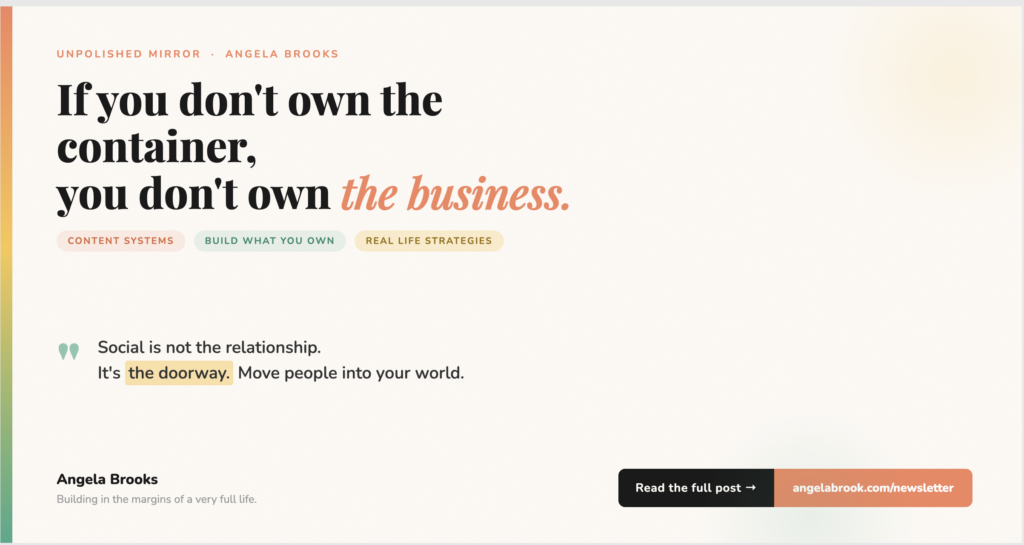
If you want your business to last, you need to own your content container. When your work lives only inside platforms or products you don’t control, your effort doesn’t compound. You can show up, be consistent, and be helpful, and still feel like you’re rebuilding from scratch because the structure itself doesn’t let your work stack.
That’s the real issue most people miss. The problem is rarely how much you’re doing. It’s where your work is being stored and whether it lives in something you actually own.
Why Owning Your Content Container Matters
When you build inside systems you don’t control, you’re always exposed to change. Platforms shift. Companies close. Products disappear. And when that happens, a lot of people disappear with them.
This isn’t a character issue. It’s a structure issue.
If the product disappeared tomorrow, would anything you’ve built still be standing? That question alone changes how you think about your business, your content, and your long-term strategy.
Owning your container means your work has a place to live, connect, and grow over time. It means your effort can finally stack instead of resetting every few months.
How AI Changes Execution (But Not Strategy)
This week I built three different landing pages for three different topics and wired the workflows behind them in under an hour using AI tools. A few years ago, that would have been a $400 to $800 project for a single page, usually without any real SEO or AEO thinking baked in. Now it costs about $20 a month for the tools.
But that’s not the real story.
It was fast because I already understood the system I work in. I knew what I was building. I knew what “good” looked like. I knew how to give feedback. I knew how to ask better questions.
When you don’t ask the right questions, you don’t get the right answers.
AI didn’t replace thinking. It compressed execution. It leveled the creation platform to anyone willing to learn how it works. The people who brush it off will miss this era in the marketplace and wish they had stepped out of their comfort zone to learn while the door was wide open.
Tools don’t create leverage. Structure and strategy do.
Building Living Systems Instead of Static Assets
That speed is also why I updated Content Map again this week. I don’t sell static systems in a world that keeps changing. If something in my process gets clearer, faster, or better, it goes into the system. You’re not working from something outdated. You’re working from what’s actually working now, in real life, in real workflows.
When I write in new updates, I send out an email that tells you exactly what section I changed so you have the details as soon as I’m finished. No guessing. No wondering if what you bought is still relevant.
This is the difference between buying information and building inside a living system.
If you want to see the structure I’m talking about, this is it:
Content Map →
The Era of the Individual Empire
The era of the individual empire is here.
Not just influencers. Not just content creators. Individuals becoming their own multi-unit businesses. Your name, your positioning, your body of work expanding into different offers, different entry points, and different ways people can learn from you, work with you, or buy from you.
Anyone with a smartphone can build something real now. That part isn’t rare anymore. What’s rare is building something that doesn’t disappear when the product, the platform, or the trend changes.
Kids in high school are becoming millionaires on YouTube by being themselves and creating content for a response. The opportunity is real. The structure is what determines who keeps it.
Social Media Is the Doorway, Not the Relationship
Here’s where I see the disconnect over and over again.
Someone raises their hand. They comment. They DM you. They reply to a story. Then what?
Do you keep the entire relationship trapped on a platform you don’t control and call that connection? Or do you move them into something you own, like your newsletter, your system, your container?
Most people stop at social. They think social media is the relationship. They’ll argue about this. They’ll debate it. If you judge that argument on two years or less of results, you usually see the pattern.
Social is not the relationship. It’s the doorway.
If you never move people off the platform, you’re not building a business. You’re warming them up for someone else to serve them better, sell to them better, or give them a clearer path.
What It Means to Build a Body of Work
This is why I care so much about containers. About systems. About bodies of work instead of scattered content.
Do I use products in my business? Of course. Some are useful. Some work really well. But they are not the container. They are part of the model. The container is what holds everything else and lets it compound.
You need something that holds your work so it can finally stack.
Stacking your business as you learn new skills compounds over time. People remember your name. They follow you silently. And then one day they show up already knowing how you think and what you stand for, because your work has been doing that job for you in the background.
Here’s another hard truth. If someone is constantly talking about how much money they make, but their content doesn’t reflect real value or usefulness, they become noise on the internet. No one cares about your numbers. They care whether you can help fix a problem they have. If you can’t, they’re gone in a flash.
Building your system is just as important as selling your product. One supports the other. Only one outlives it.
How to Start Building Something You Own
I’ll say this plainly because I was once standing in this exact place.
I didn’t see the value in an email list. I didn’t see the value in automation. I didn’t see the value in building a system before I “needed” one. I thought showing up and posting was the work.
Now I know better.
If you’re doing a lot and very little seems to stay, that doesn’t mean you’re behind. It means you’re ready for a better container. You’re ready to stop rebuilding from scratch and start building something that actually compounds.
Don’t be afraid to build something you own. Don’t be afraid to move your work off borrowed platforms and into a structure that can hold it. Don’t be afraid to treat your experience like it matters enough to organize, protect, and grow.
I see you. I’ve been there. And I know what changes when you stop renting space and start building something that belongs to you.
That’s the work I write about in my newsletter. It’s where I teach how to turn real life into a body of work that stacks and show what this looks like in real time, in real systems, not theory.
And when you’re ready for the structure itself, Content Map is the framework I use to turn scattered effort into a compounding body of work. It’s not static. It evolves as the work gets clearer, faster, and better, because your system should grow as you do.
You don’t need more platforms.
You need something that holds your work so it can finally stack.
That’s not a small shift. It’s the one that changes everything.
Frequently Asked Questions
What does it mean to own your content container?
Owning your content container means your content, audience, and systems live in structures you control, not inside someone else’s platform or company rules. This allows your work to compound over time instead of disappearing when things change.
Why isn’t social media enough to build a business?
Social media is the doorway, not the relationship. Platforms can change, accounts can disappear, and attention can shift. A real business is built by moving people into something you own, like a newsletter or system.
How does AI actually help in business?
AI doesn’t replace thinking. It compresses execution. It makes building faster for people who already understand what they’re building and how systems work.
What is Content Map?
Content Map is a living system for turning scattered ideas and experience into a structured body of work that compounds over time. It’s updated as processes improve so it doesn’t become outdated.
Why is an email newsletter important?
A newsletter is part of an owned container. It gives you direct access to your audience and a more durable relationship than relying only on social platforms.
What does building a body of work mean?
Building a body of work means creating content and assets that stack over time and build authority, instead of only posting content that disappears in feeds.
Who is this approach for?
This is for people who are already doing the work and want a more durable structure so their effort compounds instead of resetting every week.
Join my newsletter for more Content Strategy for Women tips.