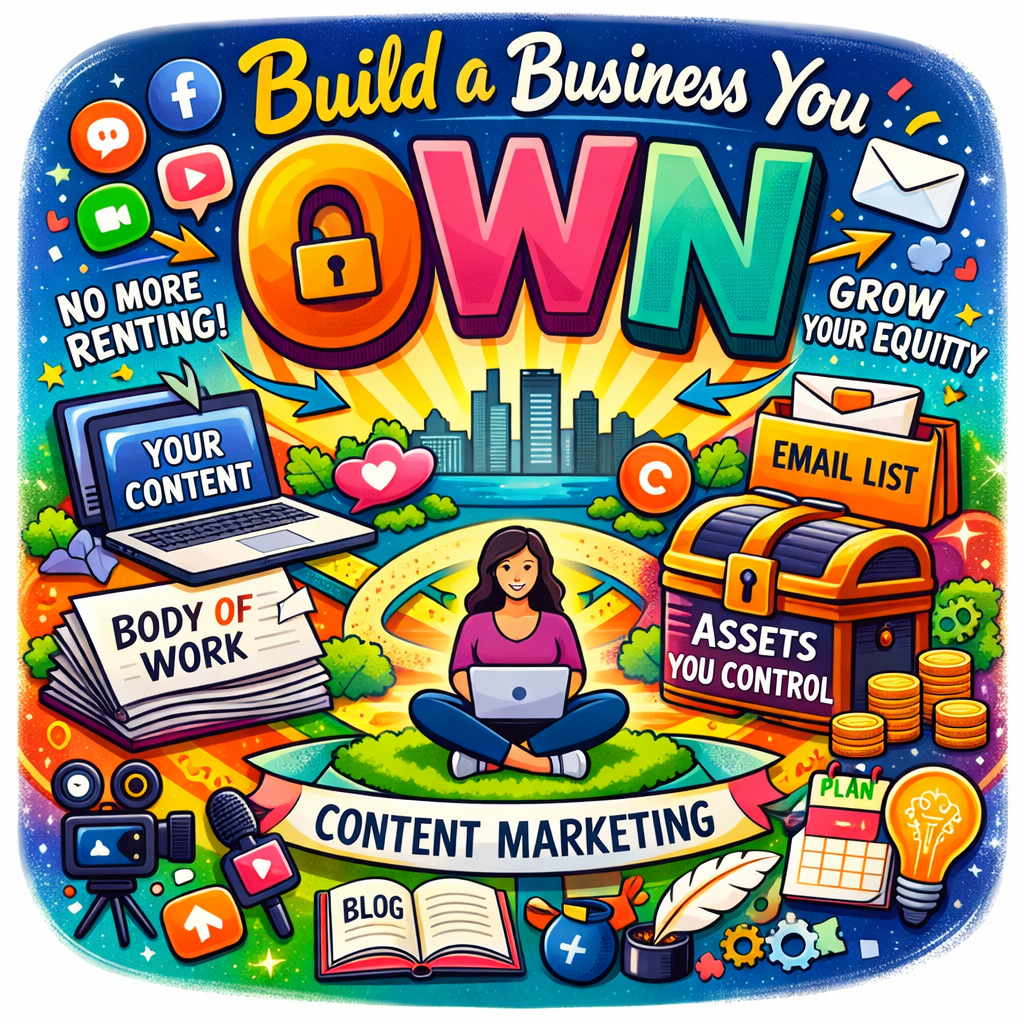
You’ve probably been told that a solid content marketing strategy for women means posting more, being more visible, and growing an audience on whatever platform is hot right now. That advice is everywhere, and it’s also the reason so many capable women are working hard and still feel like they’re one policy change away from losing everything they built.
If you don’t own the container, you don’t own the business. That’s the simplest truth I’ve learned after years of building inside other people’s systems. You can work hard, be skilled, even be successful, and still be one algorithm update away from losing your leverage. Real momentum comes from structures you control, not platforms you rent.
For a long time, I thought my problem was focus. I had nursing. I had network marketing. I had online business. I had writing that kept pulling at me no matter what I was doing. From the outside, that can look scattered. From the inside, it felt like I was moving and still not building something that actually belonged to me.
Then came the day I refused to sign the paper.
The company I was with wanted control over what I posted on social media. They wanted access to my email list. They wanted ownership of the audience I had built. I wouldn’t give it to them. They shut my account off.
Not long after that, I worked with another company for nine years. I promoted them, supported them, and made a very steady income. I had over 500 leads in their system and had moved most of those to my own email list. Then they decided to change their approach and cut off the affiliate side of the business. With one click, about $1,200 a month disappeared. Different company. Same lesson.
That moment didn’t make me bold. It freaked me out. It scared me. It took a few days to get my head clear. Then a sale came in that had nothing to do with that company. My income was smaller, but it was still moving forward. That was the moment I learned how to breathe again. That was the moment I understood what ownership actually feels like.
Why Content Marketing Strategy for Women Has to Start With Ownership
Content marketing is the backbone of the internet. If they can’t find you, they can’t become a customer. Writing, video, podcasting, whatever you choose — you have to be all in. Not inside someone else’s rules. Not inside a system you don’t control. Inside a structure you actually own.
Every real business has a way to be found. Call it leads. Call it traffic. Call it demand. The name doesn’t matter. The structure does. Google sells access to attention. YouTube sells it. Meta sells it. They’re not selling magic. They’re selling discoverability. And renting attention is not the same thing as owning an asset.
What is a content marketing strategy for women building a digital business?
A real content marketing strategy for women building a digital business means creating content in a place you own — your blog, your email list — so your work can compound into an asset instead of disappearing when a platform changes its rules. It’s not about doing more. It’s about building in the right place from the start.
The internet is full of people trying to grow an audience. What happened to growing a body of work? An audience can disappear with a policy change. A body of work compounds. It stacks. It becomes equity. That’s the difference between renting space and building something that actually belongs to you.
Scattered Interests Are Not the Problem
Here’s the real issue most people miss. Scattered interests aren’t the problem. Uncontained effort is. When your work doesn’t have a home that can store it, stack it, and let it compound, you get motion without momentum. You get activity without durable results.
A container fixes that. And a container isn’t a platform. It isn’t a project. It’s the structure that decides where your work goes, how it connects, and how it grows over time. When I stopped trying to be impressive in a dozen places and started building one coherent system, everything changed. Writing became an asset instead of a post. Content became inventory instead of noise. Small offers became building blocks instead of experiments.
Same skills. Same experience. Different container.
Why do women lose income when a platform changes its rules?
Women lose income when a platform changes its rules because the audience, leads, and content all live inside someone else’s system. When the company shuts down, pivots, or pulls the program, there’s nothing to fall back on. Building your content marketing strategy on owned platforms — your blog, your email list — means a policy change can’t erase what you’ve built.
What a Real Content Marketing Strategy Looks Like in Practice
That’s the work I care about now — helping women stop forcing their work into spaces they don’t own and start building something that can’t be taken away. Not more tips. Better structure. Not more activity. More leverage.
I’m done teaching surface-level business. I’m not here for permission-based models where your work lives on borrowed ground. I’m here for women who are already capable, already building, and can feel that invisible ceiling that comes from operating inside structures they don’t control. According to the Content Marketing Institute, marketers with a documented strategy consistently report stronger results — which is exactly why the structure matters more than the volume of content you produce.
If this resonates, the place to start is my newsletter. That’s where I teach how to turn your experience into durable assets — and where Content Map lives. It’s not about doing more. It’s about finally building something that belongs to you.
Be unpolished,
Angela
❓ FAQ
What does a content marketing strategy for women actually look like?
It means building your content on platforms you own — your blog and email list — so your work compounds into an asset instead of disappearing inside someone else’s rules. It’s less about posting volume and more about where your work lives long-term.
Why is content marketing important for building a digital business?
Content marketing is how people find you before they trust you. If they can’t find you, they can’t buy from you. A documented content strategy built on owned platforms is what turns discoverability into durable income.
What is a content container?
A content container is the structure that holds and organizes your work so it can compound into assets instead of disappearing into feeds. Think of it as the home your content lives in — one you own, not one you rent.
Is growing a social media audience enough to build a business?
No. An audience built on borrowed platforms can disappear with one policy change. A body of work built on owned platforms compounds over time and becomes something no company can take from you.
Who is this content strategy approach designed for?
It’s for capable women who are already building and want ownership, structure, and long-term leverage — not surface-level strategies that depend on someone else’s platform staying friendly.
Join my newsletter for more Content Strategy for Women tips.
Storytelling is the engine underneath all of it, and the strategy is just how you move it around.