You sat down to write and the cursor just blinked at you. Someone told you blogging was the way, so you did the thing. You wrote about whatever came to mind that day, hit publish, waited, and nothing ever came back. So you wrote another one, and another, until you had a pile of posts that did not really say anything and did not lead anywhere. If that is where you are right now, I have stood in that exact spot. I want to tell you the thing I wish someone had told me before I ever tried to write a blog post that ranks.
So here is the plain version. You can write a blog post that ranks without being an SEO expert, because ranking was never about tricks or tools or some secret only the technical people get to know. A post gets found when it answers one specific question a real person is typing into Google, gives that answer clearly near the top, and is written in a voice worth trusting. That is the whole thing. Everything else in this post is me showing you how to do those three things around a life that is already full.
I have spent 17 years in digital marketing and I have been building online since 2008, back when I was a single mother teaching myself all of this between nursing shifts. None of that is to impress you, it is so you know the rest of this is not theory I read somewhere. I learned it by writing a lot of the mess I described above and then figuring out what actually moved.
Where to Start If You Want to Write a Blog Post That Ranks
Most people think they have a writing problem, but they do not. They have a knowing-what-to-write problem, and those are two completely different things. You can be a strong writer and still freeze every time you open a blank page, because nobody ever showed you where content comes from in the first place. Once you see it, the freezing stops for good.
How do I know what to write a blog post about?
You know what to write about the moment you stop reaching for topics and start collecting questions. The strongest posts answer something a real person is already asking. The things people ask you. Problems you have already solved. The questions sitting right there in Google’s own search bar. Once you learn to see content this way, you never run dry again.
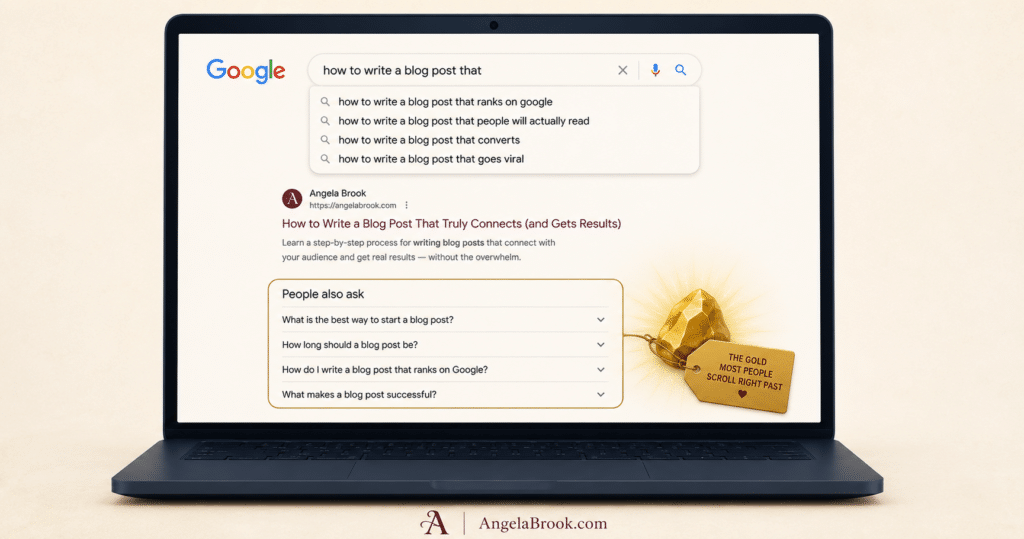
And the best part is you do not need a single paid tool to find those questions. Start typing a topic into the Google search bar and watch what it tries to finish for you. Those suggestions are real searches real people are making. Scroll a little and you will hit the People Also Ask box, which is a list of the exact questions surrounding your topic. Go to the very bottom of the results page and there is a whole block of related searches. That is hours of content sitting in plain sight, for free, before you have written a word.
Once you learn to see content this way, you cannot unsee it. Every conversation, every question, every thing you figured out the hard way turns into something you can write.
If you just want to follow along while you sort this out, I write a weekly note about how this works. It pulls back the curtain on the structure and the real numbers behind it. You can come sit in on it at the newsletter. No pressure, just the conversation.
Here is the piece that changes everything, and it is the one I missed for years. You can write about the same topic ten different ways and never once repeat yourself. One subject is not one post. It is a doorway. The same idea looks different to a woman just starting than it does to one who has tried and stalled. It looks different again to one who is doing well and wants to do better. Same topic, three different people, three different posts, none of them saying the same thing. That single realization is the difference between running out of ideas by Thursday and never running out again.
Can you use AI to write a blog post that ranks?
You can use AI to write a blog post that ranks, as long as you treat it as a partner and not a ghost-writer. It is wonderful for finding fresh angles on your topic and getting you unstuck when a paragraph will not come. What it cannot do is live your life, and that lived part is the very thing that makes a post worth trusting.
Used well, a tool like ChatGPT or Claude is the writing partner you always wished you had at the kitchen table at nine at night. Hand it the question you picked and ask it for three different angles. Paste in your rough draft and ask where it got muddy or where you lost the reader. Ask it to push back on you. What you never do is hand over the whole thing and let it write in your place. The moment you do that, the post loses the one thing no one else on the internet can offer, which is you.
For years the real barrier was not ability. It was doing this completely alone, with no one to think it through with and no one to tell you whether the idea was any good. That barrier is gone now. The help you always wanted exists, and most of it costs nothing. What always mattered most was already yours, the part you have lived and how you see it. The tools caught up to you. They did not replace you.
And when you write to answer that one real question, write it for the person asking it, not for the search engine. Google itself tells creators to put people first, because the machine is built to reward the post that actually helps a human. The clearer and more useful you are to her, the more findable you become. Those two things are not at war. They are the same thing.
When You Did Everything Right and It Still Did Not Land
So you did all of that. You picked a real question and you answered it plainly, the way you set out to write a blog post that ranks. You hit publish and braced for something to happen, and the numbers stayed flat. Before you decide your writing is the problem, let me save you that conclusion, because it is almost never the real reason.
Why isn’t my blog post showing up on Google?
Most of the time it comes down to a handful of things. The post did not answer one clear question. Maybe the answer was buried in the middle instead of near the top. The post is simply new and Google has not indexed it yet, which takes time. Or the way people search shifted underneath you and the post was built for the old way. Nearly all of it is fixable.
That last one is the big one, and it is bigger than most people realize. The way people find answers changed completely over the last couple of years, and a post written for how search used to work can be invisible in how it works now. I will not cram that whole story in here because it deserves its own room. If your posts are getting quieter and you cannot figure out why, read what actually changed in search and how to fix it next. That post picks up exactly where this one leaves off.
The Part You Keep Refusing to Give Yourself Credit For
Now to the question you did not type into Google but have probably asked yourself in the quiet. It is the one that keeps the most capable women from ever starting, so I want to answer it straight.
Do you have to sound like everyone else to rank?
No, and trying to is exactly what buries most blogs. The internet is full of posts that read like they came off the same assembly line, and readers and search engines both scroll right past them. The voice you keep apologizing for is not your liability. It is the one thing on the whole page that cannot be copied.
The thing that cannot be replicated is the part you keep leaving out. What you have already lived is the content.
Nobody can write my years as a psychiatric nurse the way I lived them. Nobody can replicate how I raised my children or what I learned getting through the hard turns in business that did not go the way I planned. That is not a brag. It is the point. And the exact same thing is true of you. You are sitting on a lifetime of things you figured out, survived, and understand in your bones. And you keep waiting for some bigger turning point of knowledge before you let yourself write any of it down. There is no bigger turning point coming. The credential you are waiting for is the life you already lived.
That is what makes a post worth trusting, and trust is what makes it worth ranking. You do not have to become someone else to be found. Your only real job is to stop discounting the one person only you can be.
You know how to write the one post now. Here is how to make it travel.
A post that ranks is the start, not the finish. The next move is taking that one strong piece and letting it work across every platform instead of disappearing after a day. That is the entire idea behind the Content Map. One article, structured for search and for the way AI reads now, sent out across six platforms so your work compounds instead of vanishing. If you are ready to make one post do the work of ten, this is where you start.
And if you are not there yet and you just want to watch how this gets built in real time, the newsletter is the open door. It is where I share the real version every week, including how I take one post and spread it across every platform so nothing I write only lives for a day.
You were never short on ability. You were short on knowing where content comes from and short on giving yourself credit for what you already carry. Everything it takes to write a blog post that ranks was already in your hands. Fix those two things and the writing was always going to be the easy part.
Be unpolished,
Angela