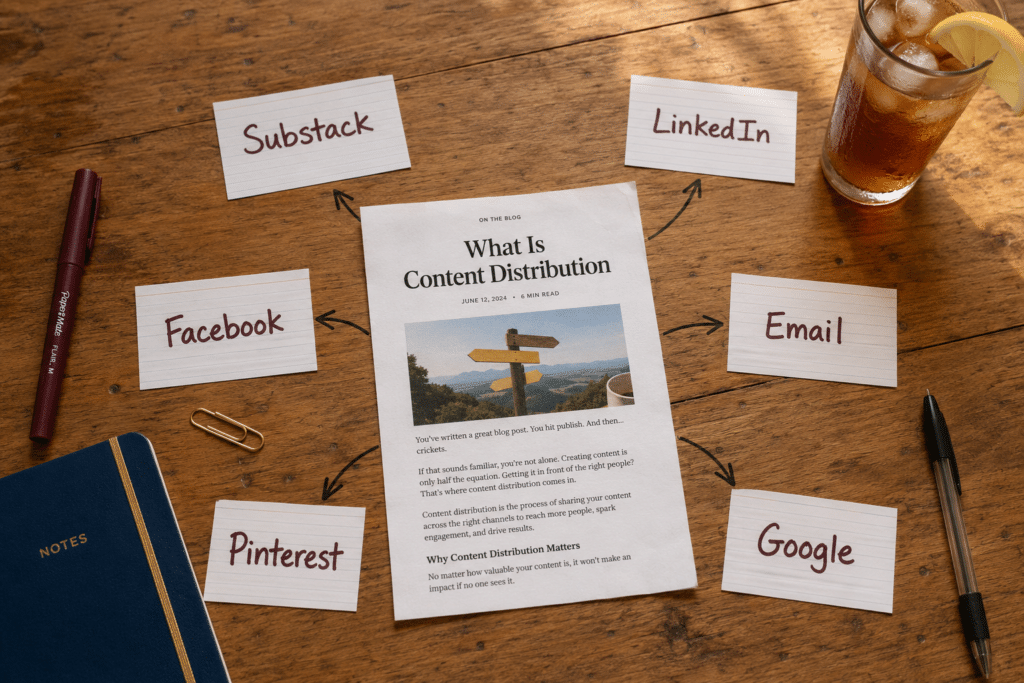
You hit publish on a Tuesday morning and you felt good about that post. It was honest, it was useful, and you knew there was a woman out there who needed to read it. Then Tuesday became Wednesday, and the views sat at four. By Friday they had crawled to six. So you opened a blank page and started writing the next one, because writing the next one is the only lever you know how to pull. Nobody ever taught you the second half of the work, and that second half is content distribution.
Here is the honest answer to what you are actually missing. Content distribution is the work of taking one finished piece of content and moving it in front of readers on every channel where they already spend their time, instead of publishing it once and hoping it gets found. Writing more posts will not fix flat traffic, because the problem was never how much you wrote.
This matters more than almost anything else you could fix this year. The gap between a post that disappears and a post that builds an audience has very little to do with talent and almost everything to do with what you do after you publish.
Angela Brooks has spent 17 years in digital marketing, and the most common pattern she sees in capable women who write beautifully is this exact one. They are excellent at making content. They were simply never taught the second half of the job.
Publishing Makes Your Post Exist. Distribution Makes People Find It.
Most people believe that hitting publish is the finish line. It is not even close to the finish line. Hitting publish only makes your post exist. It places a new page on your website, and then it waits. It cannot walk itself over to a single reader, and it cannot tap anyone on the shoulder. A published post with nothing pointing toward it is a parked car with no wheels on it, and writing another post just parks a second car next to the first one.
Distribution is the part that gives a post its wheels. It is you taking that one finished article and deliberately placing it where your readers already are, shaped to fit each place, so the post actually arrives instead of sitting in a driveway waiting to be discovered. Publishing is a passive act. Distribution is an active one. That single difference is the reason some writers compound and most writers start over every week.
Quiet next step
If you want the version of this conversation that lands in your inbox every week, including the real numbers and the structure underneath it, you can follow along with the newsletter. There is no pressure to do anything with it. It is the quieter conversation behind these posts.
Why Content Distribution Matters More Than Writing More Posts
It feels productive to write the next post. It feels like real progress. The trouble is that writing more only works if the writing was the bottleneck, and for most women it is not. Surveys of working bloggers point in the same direction year after year. The writers who report real results are rarely the ones producing the most. They are the ones who put genuine effort into getting each post seen.
What is the difference between content creation and content distribution?
Content creation is the act of making the thing. That means writing the post, recording the video, or building the resource. Content distribution is the act of getting that finished thing in front of people. Creation puts your work into the world. Distribution puts your work in front of actual eyes. Most writers do the first one well and skip the second one entirely.
Why isn’t writing more blog posts getting me more readers?
Writing more blog posts does not get you more readers because every new post restarts the discovery problem from zero. A brand new post has no traffic, no links pointing to it, and no readers who know it exists yet. Without distribution, you are pouring water into a bucket that still has a hole in it instead of patching the hole.
You do not have a writing problem. You have a distribution problem. The post that changes your business this year is very likely one you have already written. It is sitting on your website right now, finished and capable, just waiting for someone to give it wheels.
What Content Distribution Actually Looks Like
Content distribution is not complicated, and it is not a second full-time job stacked onto the one you already have. It is one repeatable pattern applied to every post you publish. You take the article you already wrote and you reshape it for the handful of places your readers already are.
When Angela Brooks publishes one post, that post is never shared a single time and then forgotten. It becomes several Facebook posts spread across different days, a LinkedIn article, a Substack piece, an email to the list she is building, and a Pinterest pin that keeps sending readers in for months. The post itself is also structured so that Google and AI search can read it clearly and cite it. That is one article and six different places a reader can find it, and it is exactly the pattern the Content Map lays out step by step, so distribution becomes something you run instead of something you reinvent.
How many places should you share one blog post?
Aim for at least five or six places for every post you publish, and plan to share more than once. A single blog post can become a Substack article, a LinkedIn post, several Facebook posts across different days, an email, and a Pinterest pin. Sharing a post one time on one platform is the most common reason genuinely good writing goes unseen.
The writer who shares one post six ways will always outgrow the writer who writes six posts and shares each one only once.
Key Takeaways
- Publishing only makes a post exist. Distribution is the work that gets it found.
- Writing more posts restarts the discovery problem every time instead of compounding what you have.
- Content creation and content distribution are two separate jobs, and most writers only do the first.
- One strong article can live on five or six platforms, reshaped to fit each one.
- Sharing a post a single time is why good content stays invisible.
- A repeatable distribution pattern turns work you already finished into readers who keep coming back.
This is for the woman who writes well, publishes on a regular schedule, and genuinely cannot understand why the numbers stay flat. The writing was never the real issue. The missing half was distribution, and that half can absolutely be learned.
The Unpolished Take
Here is the part very few people will say out loud. Distribution is the number one thing writers skip, and it is also the number one thing that separates a blog that earns from a blog that simply exists. It is not glamorous work, and it will never feel as creative as writing the post did. It is, however, the work that decides whether anyone reads what you made, and it is one of the real things that turns a blog into a business instead of an expensive hobby.
You can keep writing more and hoping the next post finally breaks through. You can also take what you have already written and start giving it wheels. One of those paths leads to a taller pile of unread posts. The other one builds an audience that finds you, comes to trust you over time, and eventually buys from you, because they have come across you in six places instead of catching you once and forgetting.
If you want the structured version of this, the exact way to take one article and move it across Substack, LinkedIn, Facebook, email, Google, and AI search without it becoming chaos, that is the entire purpose of the Content Map. It is the repeatable system written out in full, so you are not rebuilding it from memory every single week. You can see everything it covers at https://angelabrook.com/Content-Map.
And if you simply want to follow the thinking behind posts like this one, the newsletter is the quieter way in. You can join it at https://angelabrook.com/newsletter and build the foundation one steady week at a time.
Be unpolished, Angela.
Distribution and duplication are close cousins, and the duplication side is worth understanding on its own.
All of it sits inside a wider content strategy.
Distribution only carries something worth carrying, which is why the story is the part that travels.