Blogging without being an expert feels like something you are not allowed to do, and that feeling has stopped more women than the blank page ever has.
It usually arrives as one sentence, said quietly, before she ever opens that page.
I am not good enough yet, so there is no point in starting.
Or the other version, which sounds different and is the same thing underneath. I would not know what to say.
I want to sit with that one for a minute, because it might be the most expensive sentence in this whole business, and almost nobody argues with it properly.
The next three days show you how to talk to AI using your own story, so what comes back sounds like you.
Blogging without being an expert works because you are one step ahead of her
Search blogging without being an expert and you will get the same answer from everybody. You do not need to be an expert, you only need to know more than your audience.
That answer is true as far as it goes, and it is close to useless, because it tells you nothing about what to put on the page tomorrow morning.
What it leaves out is the part that actually matters. The woman reading you is not looking for somebody who knows everything. She is looking for somebody who was standing exactly where she is standing a little while ago and can tell her what happened next.
An expert who is three hundred steps down the road cannot remember what it felt like to be stuck where she is. You can, because you were there in March and you still have the notes. Knowing exactly which woman you are just in front of is the same decision as working out whether your niche is too broad. That is not a weaker position than the expert’s. For the woman reading, it is a better one, because you are close enough to be believable and close enough to be followed.
She also does not have to translate anything you say. The expert is answering a question she has not thought to ask yet. You are answering the one she typed into Google at ten o’clock last night.
Google put this in writing back in 2022, when it added a second E to the guidelines its search raters work from. Experience, meaning first-hand life experience with the thing you are writing about, now sits beside expertise rather than underneath it. Blogging without being an expert is not a loophole you are sneaking through. It is one of the things the people grading search results are told to go looking for.
Can you start a blog without being an expert?
Yes, and the position you are in is often the stronger one. A reader is looking for somebody a step or two ahead of her who still remembers the stuck part, not somebody so far down the road that the answer arrives in language she has to translate. What you need is a record of what you have actually tried, not a credential.
Your blog is the journey you are on, not the report you file at the end
This is the part I wish somebody had handed me years earlier than they did.
A blog is not a place where finished people go to publish their conclusions. It is the record of somebody building something, written while she is still building it.
You are taking her along with you. What you tried and how it went. What worked, including the bit where you were not sure it would. What did not work at all and cost you a month you would like back. What you believed in January that you have completely changed your mind about by September, and what changed it.
Nobody needs you to have arrived. They need you to be moving, out loud, somewhere they can watch it happen.
That one shift changes what you are allowed to write about, and it changes it enormously. You thought you had nothing to say because you were measuring yourself against a finished expert. Measure yourself against the woman two steps behind you instead and you have something worth writing every single week, because every week you learn something she has not learned yet.
My own message has changed more than once over the years. Not because I was wrong to start, but because you cannot think your way to the right version from a standing start. You write, you watch what lands, you adjust, and the blog carries the whole record of that. The women who have read me the longest did not stay because I had it right at the beginning. They stayed because they could see it being worked out.
What you already have to write about, before you learn one new thing
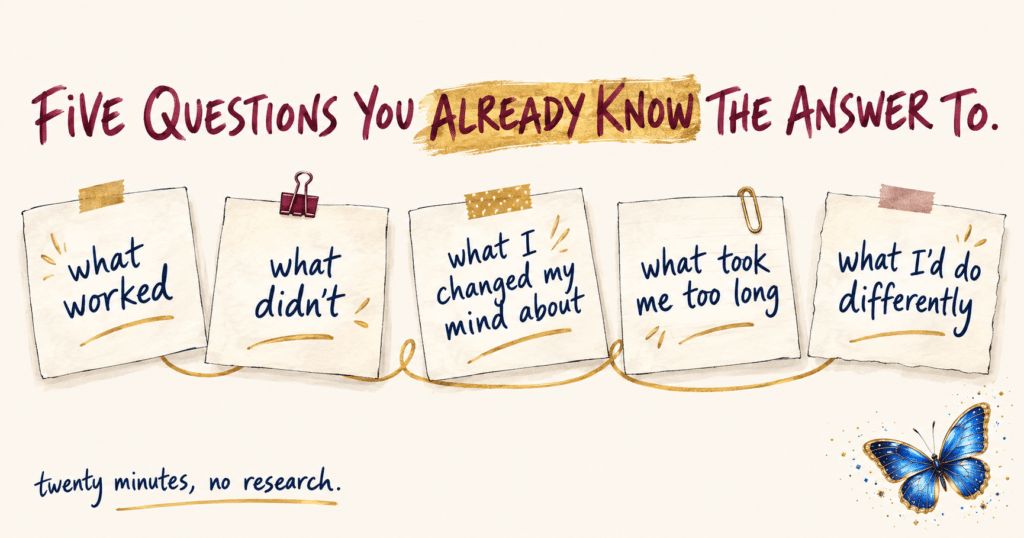
Give yourself twenty minutes and go back over the last year of whatever you have been building. Five questions, and you are already carrying the answer to every one of them.
What have you tried that worked? Write down what you did and the fact that you were not certain about it, because the uncertainty is the half that makes it believable.
What have you tried that did not work? That one is worth more than the first, and almost nobody publishes those, which is exactly why they get read. A woman searching at eleven at night for whether a thing is worth her money is desperate for somebody who will say it was not worth mine, and this is what I would do instead.
What did you believe when you started that you no longer believe? There is a whole post in that one, and it is the kind of thing a reader remembers you for, because it proves you are paying attention rather than repeating what you were told.
What took you far longer to understand than it should have? Somebody is in the middle of that exact confusion today and cannot find a straight answer anywhere, because the people who know it now have forgotten it was ever hard.
What would you do differently if you were starting over on Monday? Of the five, that is usually the most useful thing you own.
Not one of those requires expertise. Every one of them requires only that you have been paying attention to your own life, and you have.
What do you write about when you are blogging without being an expert?
Write what you have already lived through in the last year. What you tried that worked, what you tried that failed, what you have changed your mind about, what took you far too long to understand, and what you would do differently starting over. Those five produce a year of posts and not one of them needs a credential behind it.
Pick your days before you pick your words
Before you write anything, decide how many days a week you are going to publish. Not how many you wish you could manage. How many you will still be doing in March when nobody has clapped yet.
Mine are Tuesday and Thursday. That is not a recommendation, it is just mine, and the only reason it works is that it was decided once and I stopped renegotiating it every Sunday night.
Then pick one topic and stay on it. I know how that sounds. Like you are signing up to write about one small thing for the rest of your life, and that is not what it is at all.
Mine is blogging. That is the whole topic, and think about everything that lives inside it. How to start one, what to write about, getting found in search, building an email list off the back of it, which images actually get clicked, Pinterest, making money from it, writing alongside AI now that AI is here, and keeping all of it going around a full time job. I have been writing about blogging for years and I have not run out of things to say, because a topic is a lane rather than a sentence.
Pick the lane. One thing you are willing to be known for, with a great deal of room to move around inside it.
The part that takes the panic out of it is this. You are not hunting a brand new idea every time you sit down. You are looking at the same topic from a different direction, and the questions above have already handed you four of them. What worked is one post. What did not work is the next one. What you changed your mind about is a third. The thing that confused you for months before it finally clicked is a fourth.
Same topic, four directions, and you have not had to invent a single new thing.
You do not have to think all of this up by yourself
Picking your days is the easy half. Choosing the topic, finding the four directions, and writing a title somebody actually clicks is where most women stall out, and they stall out because they are doing it alone at nine at night.
Inside the Content Map I show you how to use AI as a working partner for that part. How to pull topics out of what you already know, how to turn one topic into a week of ideas, and how to write title hooks that make a woman stop. Blogging changed when AI arrived and it is not going back, and for research and ideas it is the most useful thing to happen to a writer working around a job.
You also get the Weekly Rhythm Checklist that tells you which piece belongs to which day, the Content Repurpose Workflow that puts one idea across Substack, LinkedIn, Facebook, Pinterest, email and search, a walkthrough for each of those platforms, and four chapters on training AI to sound like you rather than like everybody else. Nothing downloads, so you log in and keep it open in one tab while your post sits in the other.
Thirty seven dollars, one time. Lifetime access and free updates as the platforms keep changing. It is online training you log into and read in chapters while you work, not another download you never open.
The part nobody says out loud about blogging without being an expert
Blogging without being an expert is not the hard part. The slow part is, and I am not going to sell you a fast version of it, because there is not one and you have been told otherwise plenty of times already.
Blogging is not a project you finish. It is something you build and then keep building on top of, where the thing you put up this month sits underneath the thing you put up next month and holds it up. That is why it feels like nothing for a while and then feels like something all at once, and it is also why the posts you already have are worth going back to rather than leaving behind.
If you start now and stay with it, you are looking at something like ninety days before you see anything solid, and that is only if you keep going. Not ninety days of occasionally. Ninety days of actually showing up on the schedule you set for yourself. If you are still working out whether any of this turns into money, start with whether a blog can really pay you.
I would far rather you hear that from me now than quit in week six believing you failed, because week six is exactly where it feels like nothing is happening, and week six is where most women stop. Nothing has gone wrong at week six. You are just standing in the part of this that nobody photographs.
The two things it genuinely takes are commitment and consistency. Not talent, and not credentials. A woman who writes an honest, ordinary post every single week for a year will be further along than a brilliant writer who published nine times when she felt inspired.
How long does it take to see results from blogging without being an expert?
Plan on ninety days before anything solid shows up, and only if you publish on the schedule you set rather than when you feel inspired. Week six is the stretch where nothing appears to be working and most women quit, and nothing has actually gone wrong at week six. Consistency is doing more of the work here than talent or credentials ever will.
The longer you blog, the more the structure is what pays you
Something else happens across those months, and it caught me off guard.
The writing gets easier, which everybody expects. What nobody warns you about is that the writing was never the hard part. The structure underneath it is.
You learn where the next step belongs on a page, and which post should be pointing at which other post and when. You learn what belongs at the bottom of an article and what belongs in an email instead. You learn that the bottom of a post should ask your reader to do one thing instead of five, because a woman looking at subscribe and follow and comment and read these three other posts all at once will do none of them.
That is what turns consistent writing into results, and it is the reason two women can publish the same number of posts in a year and only one of them has anything to show for it. The difference is almost never the talent. It is that one of them was building a structure and the other one was producing articles.
The piece of this I can hand you right now is the smallest one. Open the post of yours that gets the most traffic, go to the bottom of it, and count what you are asking her to do down there. If it is more than one thing, cut it to one. That takes ten minutes and it is the first piece of structure most women ever put in place.
The bigger half is knowing what to publish on which day, and how one idea reaches seven places without being rewritten seven times. That is what the Content Map lays out, and it is the part that took me the longest to work out on my own.
A machine is reading those same pages now
One more thing worth knowing, and it is newer than everything else here.
When somebody asks AI about your subject, the answer gets assembled out of whatever has been written down where a machine can reach it. Nothing in that process is weighing your credentials. It is weighing whether there is anything there at all, and whether what is there is clear enough to understand and repeat.
A woman who has been publishing what she learns, in order, for a year has far more of a record than a woman who has not started yet. She also has a record that says what she is about, which is the thing that has to exist before anything can name her.
Waiting until you are an expert does not make you more findable. It only means there is nothing yet to find. If you want to see what is there right now, this is how to check what AI says about your business.
Does blogging without being an expert hurt you with AI search?
No, because nothing in that process is checking your credentials. What gets assembled into an answer is whatever has been written down clearly enough for a machine to understand and repeat. A year of ordinary posts pointed at one subject gives it far more to work with than waiting until you feel qualified, which gives it nothing at all.
Start where you are, on purpose, and let her see it
Blogging without being an expert only works if you stop pretending to be further along than you are, and I would go further than that and say the pretending is the thing that costs you, because the pretending is usually the thing that makes a blog sound exactly like everybody else’s.
Tell her where you actually are. Tell her what you are working on this month. Tell her what went sideways and what you did about it, and what you are trying next.
One line worth holding to while you do it. You can write about anything you have actually done, and nothing you have not. Not being the expert gives you permission to write from where you are standing, and it is not permission to borrow somebody else’s results and talk about them like they happened to you. The woman who finds out later is the one who was going to buy from you.
The woman reading that does not think less of you for it. She thinks finally, somebody is telling me the truth about this, and she comes back to see what happened.
That is what makes her stay, and the staying is the whole thing, because nobody has ever bought anything from somebody they read once. Blogging without being an expert is not a smaller version of this work. For the woman reading you, it is the believable version.
Go back to those five questions and pick the one that made you wince when you read it. That is the post. Write that one this week.
When you are ready for the system that keeps it going every week, the Content Map is here.
New around here? Start here and work forward.
Be unpolished,
Angela.