You have posts on your site right now that are bringing people in and have never made you a dollar. Every piece of advice you will find tells you to update old blog posts for SEO, which means refresh the date, fix the broken links, add a section, request indexing, watch the rankings.
You already own the pages that could be earning, and in three days I will show you how your own story becomes the thing you sell from them.
All of that works, and none of it is your problem. When people tell you to update old blog posts, that is the whole of what they mean, and it stops one step short of the thing that would pay you.
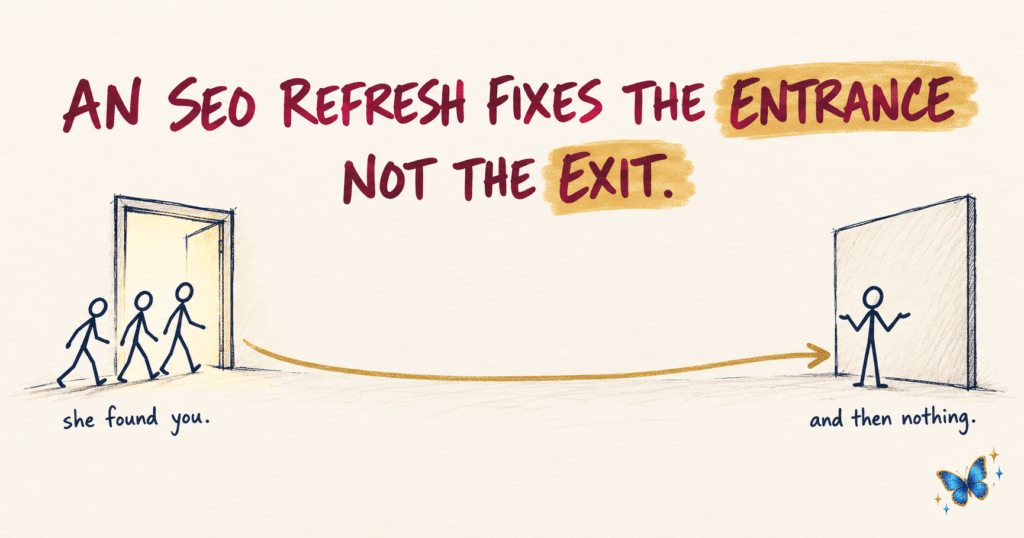
An SEO refresh improves the entrance. A woman finds the post, the post is better than it was, more women find it. What happens to her after she finishes reading is exactly the same as it was before, which is that she gets to the bottom of the page and leaves.
The post does not have a missing keyword. It has a missing exit.
An SEO refresh fixes the entrance, not the exit
Think about one of those posts for a second. Somebody searched a question, landed on your page, read the answer, and then what.
Most of the time there is nothing there. Maybe a general invitation to join a list, written years ago and not really about the thing she just read. Maybe a related posts widget the theme put there on its own.
She came in with a specific problem on her mind and she left the same way, and the whole encounter cost you nothing and earned you nothing.
Now multiply that by however many people have read that post since you published it. That is the number that should bother you, and it is not a traffic number.
Traffic you already have is cheaper than traffic you are chasing
This is the part I want to sit on, because it changes where you spend your Saturday.
Traffic you already have is worth more than traffic you are hoping for. The woman reading your three year old post found you without you doing anything this week, which means she is the cheapest reader you will ever get.
A new post has to earn its audience from nothing. An old post with steady traffic already has one, and it is standing in a room with no door out.
Most of us spend every available hour writing the next thing while the posts already working sit there unfinished. Not unfinished as in badly written. Unfinished as in nobody ever built the part where she can do something next.
Which is the real reason to update old blog posts rather than write another one this week. The audience is already there and the page is not finished.
Start with the post that already gets traffic, not the one you like best
Open Search Console and sort your pages by impressions over the last twelve months.
The list that comes back is usually shorter and stranger than people expect, and it is almost never the posts you are proudest of, which has certainly been true every time I have looked at mine.
Take the top ten and ask one question about each. Is the woman reading this close to needing something from me, or is she just curious.
A post answering what is a sales funnel is a curious reader. A post answering how do I get my first affiliate sale is a woman two steps from spending money, and she is the one worth your afternoon.
Pick the highest impression post where the reader is closest to needing help, and work on that single post rather than trying to fix all ten of them this weekend.
The order you update old blog posts in decides whether the hour pays you back, which is why this step is worth doing before you touch a single word.
Four Changes to Make When You Update Old Blog Posts, and None of Them Are Keywords
Here is what I actually change, and it takes about an hour per post.
The next step has to match the question she asked. If the post answers how to pick a niche, the next step is the thing that helps her pick a niche, not a general invitation to hear from you on Thursdays. A matched offer converts several times better than a good offer in the wrong room, and that gap is the whole reason generic boxes do nothing.
Give her one offer rather than three. Most old posts that do have something at the bottom have three things, a list signup and a related post and a product, which is the same as having none. She will not choose, she will scroll.
The opt-in has to be about that post. The same generic signup box sitting at the bottom of forty different posts is a box she has already ignored thirty nine times. Written for the specific thing she just read, it stops being furniture.
One internal link, pointed forward. Not a related posts grid. One sentence inside the body, where the question naturally comes up, pointing at the post that moves her one step closer to needing what you sell.
Do those four and leave the keywords alone entirely on the first pass. The post is already ranking well enough to bring her in, so the entrance is not what is broken.
Watch those four changes land on one three year old post
Let me walk one through so this is not abstract, and I am going to use a made up post so you can map it onto your own.
Say the post is called How to Set Up Your First Email List, it has been up three years, and it gets a steady trickle of women every month who are starting from nothing.
What is on it now is an opening about why email matters, step by step instructions with screenshots that are two platforms out of date, and at the bottom a box inviting her to join the mailing list of a woman she met four minutes ago.
Here is how I would rewrite it. The step by step instructions stay exactly where they are, because they are the reason she is there and the reason Google sends her.
The matched next step becomes the question she will hit about ninety seconds after she finishes, which is what do I actually send these people. That is not a different topic, it is the very next thing, and she is thinking about it before she closes the tab.
The opt-in on that specific post then becomes the first three emails to send a brand new list, written out and ready to copy. The internal link in the body, placed in the paragraph where she picks a provider, points at the post about what to write once people start subscribing.
The generic join my list box comes off entirely, because it was asking a stranger for a commitment while giving her nothing she came for.
Nothing about the keywords changed. The post now catches a woman who was already there and hands her the next thing she needs, which is the whole job.
Should you update old blog posts?
Yes, and start with the ones already getting traffic rather than the ones you like best. The reason to update old blog posts is that those pages have an audience arriving every week and nothing on them for her to do next. Build the next step into the page first and do the keyword work afterward.
Most of your pages have curious readers, and they need a link rather than an offer
Most of your list will be curious readers, and I am not going to pretend otherwise.
A post answering what is an email list is read by somebody three decisions away from spending a dollar, and the mistake there is pushing an offer at her anyway, which reads as desperate and converts at nothing.
What those posts are for is moving her one step along, and you do that with the internal link rather than the offer. One sentence in the body pointing at the post she will need next, written as help rather than navigation.
A curious reader who clicks that link has done something far more valuable than joining a list. She has shown you she is still going, and now she is on a page where an offer makes sense.
Which means the curious posts and the close to buying posts have different jobs, and the mistake is giving them the same bottom of the page.
Why You Update Old Blog Posts for Money, Not Rankings
I am not telling you to skip the SEO work. I am telling you it is the second job and almost everybody does it first and stops there.
Once the exit exists, go ahead and update the date, replace the stale example, tighten the opening, and request indexing so the change gets picked up quickly rather than whenever.
The order matters more than it sounds like it should. Doing SEO first means more women walk into the same empty room, and you will see the traffic climb and the money stay flat, which is the most discouraging possible outcome because it looks like progress.
Doing the exit first means every new reader the refresh brings you lands somewhere that goes somewhere.
How do you update old blog posts for SEO?
Update the publish date, replace outdated examples and screenshots, tighten the opening, repair broken links, then inspect the URL in Search Console and request indexing, and do all of that as the second job rather than the first. When you update old blog posts for SEO before building a next step into them, you increase the number of readers who arrive and leave without doing anything.
One post a week, and in three months a dozen pages are earning
You are not rewriting your site. You are picking one post a week and finishing it.
Four posts a month, and after three months you have a dozen pages that bring people in and hand them something to do. Those pages keep working while you sleep, which is the part everybody promises you about blogging and almost nobody explains how to build.
Nobody is going to applaud you for this. You update old blog posts quietly, one at a time, and the result shows up as money rather than as a publishing streak anybody can see.
I have a post on my own site that is ten years old and still bringing in new readers every month. It took ten years to earn that and I could not go buy it back.
What I have learned the hard way is that a page like that is not a trophy. It is a room with people walking through it, and the only question that matters is whether there is a door on the other side.
If you are still working out whether any of this turns into money at all, start with whether a blog can really pay you. If you are not sure what your pages currently say about you to a reader or a machine, this is how to find out what AI says about your business.
Finishing the post is half of it, putting it in five places is the rest
There is a second half to this that most women skip, and it is the reason the first half underpays.
Once a post actually has an exit, it is worth sending traffic to on purpose rather than waiting for search to do it. That same post can become a Substack letter, a LinkedIn article, three Pinterest pins and a Facebook post without you writing anything new, and every one of those is another door into the page you just finished.
Before you picture losing a whole Saturday to this, let me say how it actually works, because I do it differently than you probably should.
I build everything for a post in one sitting, all the platforms at once. That is because I publish twice a week and it is the only way the math works for me, and it is not what I would tell you to do.
If you are putting out one article a week, spread it across the week instead. The post goes up Monday, you make your pins Tuesday, you write the Facebook post Wednesday, the letter goes out Thursday.
Twenty minutes a day beats a four hour block you keep not having. The piece is in five places by Friday and you never had to clear an afternoon.
That is the part nobody tells you, and it is the difference between a system you keep and one you abandon in three weeks.
Finish one old post this week, then put it everywhere. That order is how a page you wrote three years ago starts earning, and it is why you update old blog posts for the exit before you touch the entrance.
One post, five places, twenty minutes a day
That rhythm is what I built the Content Map for, and the rhythm is the part that is actually in there. One idea becomes a full week of content across Substack, LinkedIn, Facebook, Pinterest, email and search, and it tells you which piece belongs to which day so you are never looking at the whole week at once.
If you have never done this before and have no idea where to start, that is the point of it. It walks the steps in the order you take them, built for a woman fitting this around a job, and the checklists come down off the screen so you can keep one beside you while you work instead of rereading a page every week.
Thirty seven dollars, one time, with lifetime access and free updates as the platforms keep changing. It is online training you log into and read in chapters while you work, not another download you never open.
New around here? Start here and work forward.
Be unpolished,
Angela.