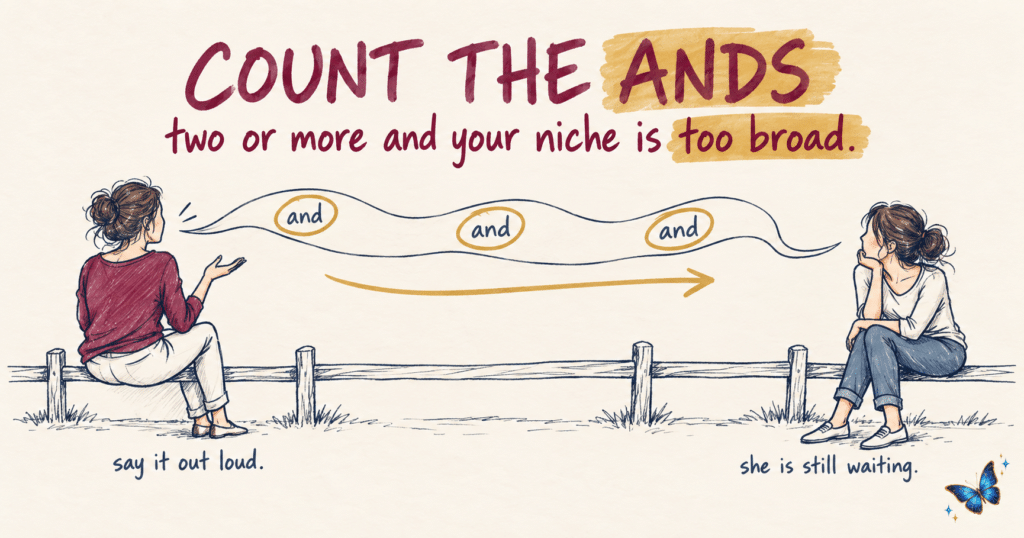
Tell me what your blog is about, the way you would say it to your neighbor across the fence. Out loud, before you read another line. Now count the ands. If you used two or more, or you heard yourself tack an and also onto the end, you are looking at a niche too broad to sell from. That is the whole test. It takes four seconds and it is more honest than any worksheet.
Once you know who you are for, your own story becomes the thing you sell.
Nobody needs to tell you to narrow things down. You have heard it from every corner of the internet for years, usually paired with a drawing of three overlapping circles labeled passion, skill, and market demand, and usually followed by somebody telling you to pick a lane and stay in it.
That advice is not wrong, it is just not useful, because it shows you what the finished thing looks like without telling you how to find yours. It also leaves you sitting there with a year of published work wondering whether a niche too broad means all of it goes in the bin so you can start clean.
None of it has to go. Repairing a niche too broad is much smaller work than everybody makes it sound, and it is not the one you are braced for.
A niche too broad is not a subject problem, it is a reader problem
The first instinct here is almost always the same one, and it was mine too for longer than I would like to admit.
The moment you decide your niche is too broad, the instinct is to start cutting subjects. Drop the money posts, drop the mindset posts, keep three things and be known for those. It feels responsible and decisive, and it leaves the actual problem sitting right where it was.
A topic is what you write about. A niche is who you are writing for and the specific problem she walked in carrying. Those are two different things, and most of the advice online collapses them into one, which is exactly why you can cut your topic list in half and still end up with a niche too broad for anybody to describe back to you.
You can write about email, Pinterest, old blog posts, pricing, and finding time after work, and still have a tight niche, as long as every one of those pieces belongs to the same woman with the same problem. You can also write about one single subject for two years and have no niche whatsoever, because not one person can tell who it is for.
The problem is almost never how many things you write about. It is that nothing on the page tells her who it is for, and that is a far easier thing to fix.
Four signs of a niche too broad, and none of them are about passion
These are the four I would actually check, and all of them look at evidence rather than asking you how you feel about your work.
It takes you two sentences. When somebody asks what you do, the answer comes out as a subject, then a qualifier, then one more piece for the women it also covers. The length of your answer is the measurement. A demographic on its own does the same thing, because women over forty do not all have the same problem and that phrase tells her nothing about whether you are for her.
Your menu does not agree with itself. Open your own navigation and read your category names in a row. If two of those categories serve completely different women at completely different stages, your topics are driving the car and your reader is somewhere in the back.
People ask what you do after you have already told them. This is the most reliable of the four and the most uncomfortable to sit with. When you explain your business and the other person says something warm and vague back to you, she did not understand it, and that is information rather than an insult.
You write whatever you feel like writing. A clear niche puts a check on you. When you sit down and the only thing deciding this week’s topic is your own mood, there is nobody on the other side of the desk pulling the work toward a particular person.
One of those four is normal on any given month. Three of them together is a niche too broad to build an offer on, and it will keep showing up as flat months no matter how much you publish.
How do I know if my niche is too broad?
Say what you do out loud and count how many sentences it takes, then read your own category names in a row and ask whether the same woman needs all of them. You have a niche too broad when the answer runs past one sentence, when your categories serve women at different stages, when the person you just explained it to still looks a little lost, and when nothing but your own mood is choosing this week’s topic.
The question that does more work than any niche exercise
Set the three circles aside for a minute, because there is one question that gets further than all of them put together.
What is the sentence she says out loud about her own problem, in her own words, when nobody is listening?
Not the way you would describe her problem. The way she describes it. A woman does not lie awake thinking that she needs to improve her content strategy. She lies there thinking that she has been at this for a year and has made eleven dollars, or that she has no idea what to write tomorrow, or that everybody else seems to have been handed a manual she never got.
Your niche lives inside her sentence, never inside your category list. The industry words are the ones you reach for because they sound professional, and they are also the ones that make her feel like you are talking about somebody else.
Once you can write her sentence down in her language, a niche too broad mostly dissolves on its own, because now you have something concrete to hold every post, every title and every offer up against. It stops being a matter of taste and becomes a matter of fit.
Narrow the reader, not the topics, and you keep everything you have written
This one took me a long time to accept. When I was learning to narrow down so that I was writing to one particular woman, I could not get my mind around it. Everything in me said a bigger audience had to be the safer bet, and that talking to fewer people on purpose was the same as turning women away at the door. It took me a while to see that I had the whole thing backward, and that narrowing was not about having fewer readers.
This is the part I want you to take with you even if you forget everything else here.
Narrowing your niche does not mean shrinking your range. It means choosing one woman, with one problem, at one stage, and then letting her decide which of your existing topics stay and how each one gets written.
Pricing stays, written for her. Pinterest stays, written for her. The mindset piece stays if her problem genuinely has a mindset layer inside it, and it comes out if it was really sitting there for you rather than for her.
Almost nothing on your site gets deleted. Most of it gets rewritten at the top and at the bottom, where the promise and the next step live, and that is a far smaller job than a rebuild. It also costs you none of the history those pages have already spent years earning, which is the part that cannot be bought back. If the pages themselves need work once you know who they are for, this is how to update old blog posts so they actually earn.
Let me put that on a page so it is not abstract, using a made up example you can map onto your own.
Say you write about blogging and online income for women. That is a subject rather than a niche, and it covers a woman who has not registered a domain yet alongside a woman with four years of posts and a list of nine hundred people. Both of those women land on your site and neither one is sure you are talking to her.
Now narrow the reader rather than the list. Say it is the woman working full time who has been publishing for about a year and has not made real money yet. Every topic you already have survives that choice. The pricing post gets written for somebody setting a first price rather than raising an established one. The Pinterest post assumes about twenty minutes on a weeknight rather than a free afternoon. The old posts piece becomes about the dozen pages she already has rather than a library of two hundred.
Nothing was thrown away, and the whole site now sounds like it was built for one person, because it was.
Is a narrow niche better than a broad niche?
A narrow niche converts better because every offer, opt-in and title can answer one problem instead of gesturing at several, and Google’s own guidance on people-first content opens by asking whether you have an existing or intended audience who would find your work useful if they came straight to you. Narrow does not mean fewer readers, it means a page that a specific woman recognizes as hers, which is the opposite of what a niche too broad does to her.
What a niche too broad is actually costing you
I am not going to tell you to narrow down because somebody said it is a best practice. These four things are what it actually costs you, and every one of them shows up in what you make.
A reader who cannot tell whether you are for her will not stay long enough to work it out. She is not weighing you against your competition, she is weighing you against closing the tab, and vague loses that comparison nearly every time.
You cannot write an offer worth buying. Every product and every opt-in is the answer to a specific problem, so a niche too broad leaves you selling general helpfulness, and general helpfulness does not convert because no woman wakes up in the morning needing it.
Your opt-in boxes default to generic. When the niche is broad there is nothing specific to offer at the bottom of a page, so you end up with one general invitation sitting under forty different posts, which is a box she has already scrolled past thirty nine times without reading.
The referrals quietly stop coming. A woman cannot send her friend to you if she cannot say in one sentence what you do, however much she liked what she read, and that is the cheapest traffic there is going unused.
None of those four is really a branding problem, even though that is exactly what it feels like from the inside. It feels like you are not polished enough yet, or not confident enough yet, or that you just need a better logo and a tighter About page. What is happening is plainer than that. Fewer women stay on the page, fewer women join your list, fewer women buy anything, and fewer women send a friend your way. Those four numbers are your month. A niche too broad does not cost you confidence. It costs you each of those four, every single week, quietly.
You find your niche in what you already published, not in a brainstorm
Your niche is not something you come up with. It is something you go and find.
For a long time I was explaining myself as the product I was selling. I have always been a blogger, and I was not talking about blogging. I was talking about the actions that come after the blog, selling a product for a problem that sits further down the road than the place I actually start a woman, which is at the blog.
The difference showed up in how it felt to talk. I can talk about blogging without thinking about it and without reading a word off a page. The other one I had to remember, because the words belonged to somebody else.
You will not think your way to it. The answer is already sitting in your own business, in three places you can look at today.
Look at which of your posts actually get read, because traffic is a vote and it is almost never the posts you expected it to be. Look at what people ask you, in comments, in replies, in messages, because a question somebody takes the trouble to type out is her real problem in her own wording, handed to you for free. Look at what you can explain without preparing for it, because that is where your years of hard experience actually live rather than where you wish they lived.
Where those three overlap is not a guess, it is a finding. A niche pulled out of evidence holds up under a bad month, and one invented on a Saturday afternoon falls apart the first week you do not feel like showing up.
Here is how mine landed. People know me as a blogger. My message has changed over the years, more than once, but that part never has, and anybody familiar with my work would tell you I am a blogger and a marketer.
What I paid attention to was the question people actually bring me. They ask me to help them get started. Not to fix a funnel, not to look at their rankings. To help them get started. Some of the women who ask are serious and most are not, and both of those are useful to know.
That one repeated question is where the Content Map came from. I built it to get a woman started, and the ones who stay with it have access to learn more from me. None of that came off a worksheet on a Saturday. It was the same question arriving over and over until I wrote down what I had already been answering for years.
A niche too broad reads generic to a machine too
One more thing is riding on this, and it has nothing to do with your readers.
When somebody asks AI about your business now, the answer gets assembled out of whatever has been written down about you somewhere a machine could reach. A record that never settles on who you help produces exactly what you would expect it to, which is a description that could be about forty thousand other people doing roughly the same thing. If you want to see yours, here is how to check what AI says about your business.
That is the same problem your reader has, read back to you by software. If being named when somebody asks for a recommendation matters to you at all, the niche sits upstream of every bit of it, because nothing can recommend you for a problem your own pages never name out loud. The difference between being quoted and being the one actually suggested is its own subject, and getting cited by AI is not the same as being recommended.
These are my ladies
Mine is one woman, and I can describe her without stopping to think about it, because I was her.
She is somewhere between her thirties and her late fifties. She has a full time job and she is building something of her own in the hours around it, after work and after everybody else in the house is settled.
She is busy, and she also has a dream and an idea she wants to build. She wants to create something of her own. What she cannot tell is where she is standing on the map, which step she is on right now, or which step comes next.
She wants to start a blog, or she has one started already. She has money she is willing to spend on learning, and what she does not have is time, so she needs directions clear enough to work in small parts of her day. I built mine on my lunch breaks at work.
What she actually wants is somebody to tell her what to do next, in an order she can follow on a weeknight, without twenty steps and without being told to show up everywhere at once.
There is a stage of life in that, a real situation, something she would recognize as hers, and what she is after. Not one word of it is a topic, and that is the difference between a niche and a subject.
Yours will not look like mine. It only has to be that specific, because specific is the one thing a niche too broad can never be.
If you cannot tell which step you are standing on, this is the map
Knowing who you are for is the first move. Knowing what to do on a Tuesday night with forty minutes and a full time job is the one nobody hands you, and that is what I built the Content Map for. It walks the steps in the order you actually take them, so you are never looking at the whole thing at once and wondering which part you skipped.
One idea becomes a full week of content across Substack, LinkedIn, Facebook, Pinterest, email and search, and the weekly rhythm tells you which piece belongs to which day. The checklists come down off the screen so you can keep one beside you while you work instead of rereading a page every week.
Thirty seven dollars, one time, with lifetime access and free updates as the platforms keep changing. It is online training you log into and read in chapters while you work, not another download you never open.
New around here? Start here and work forward.
Be unpolished,
Angela.