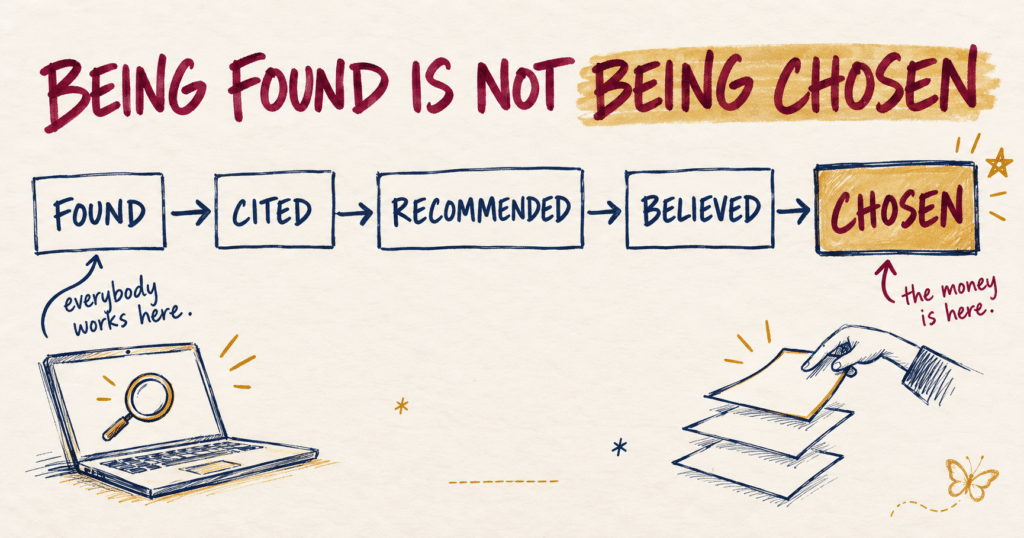
Being found is the cheapest part of building a blog, and it is the part almost everybody spends a whole year on. A blog that gets chosen is built differently. Getting found puts you in the conversation, being recommended puts you in the decision, and the steps in between are where a reader decides whether to believe you at all.
I changed direction on this in April. Instead of working to get found I started working to get recommended, and I have spent the six months since then rebuilding this blog around that one difference.
Seventeen years of writing online taught me the found part well enough. The chosen part I had to go and learn on purpose, and most of what I know came the hard way.
What happens is a sequence. A woman finds you, and then a machine decides whether to use what you wrote, and then it decides whether to put your name in front of her as the answer. She lands on your page and decides whether she believes you. Only then does she decide whether to buy.
Getting found is not the easy part. It takes months, and it is the crowded step, which is exactly why it returns the least. You can win it outright and still watch nothing come out of the other end. A blog that gets chosen earns its money in the four steps after that one.
What follows is how a blog that gets chosen is built, in the order it actually happens.
Want the Tuesday letters?
One email a week about building something of your own in the hours you actually have. Unsubscribe any time.
Why Write a Blog Post When AI Already Answers the Question
People are arguing about this one out loud, in the blogging subreddit and on Quora, where the thread runs for pages every time somebody starts it. If a woman types her question into ChatGPT and gets a clean answer in four seconds, there is no obvious reason to write the post at all.
The answer is that your post stopped being the answer and became the evidence.
She is not going to read nine hundred words to learn a definition she could have had in four seconds. She will read nine hundred words to work out whether you are the person to ask about this. The information is not what you are selling anymore. You are, and the post is how she finds that out.
Is blogging still worth it if AI answers the question first?
Yes, though the job of the post changed. It no longer earns its keep by holding the answer, it earns it by showing the work behind the answer, which is the part a machine cannot produce and a reader cannot get anywhere else. A thin post is worth less now and a specific one is worth more.
Which changes what belongs inside it. A post built to be the answer is interchangeable with the next post built the same way. A post built to be the evidence has your numbers in it, your attempt that failed, and the detail you only know because you did the work yourself.
That shift is the premise everything else rests on, and I wrote it out properly here: If AI Can Answer the Question, What Is the Blog Post For?
Being Cited by AI Is Not the Same as Being Recommended by AI
It took me a long time to see the difference between those two, and it changed what I work on.
When AI quotes your paragraph, it used you. Your words went into an answer somebody read, and your name may or may not have traveled with them, which makes you raw material rather than a recommendation.
When AI tells a woman she should go and look at your work, it recommended you. That is a different event entirely, and it is the one that puts your name in her head rather than your sentence in her answer.
What is the difference between being cited by AI and being recommended by it?
Citation sends your words and recommendation sends people. A citation carries your sentence into somebody’s answer and leaves your name out of it, which gives you nothing to build on, while a recommendation puts your name in front of a woman who is already deciding. That gap is the difference between getting found and getting chosen.
Being cited feels like winning and pays almost nothing. The move from one to the other is here: Getting Cited by AI Isn’t the Same as Being Recommended
How to Check What AI Says Your Blog Is About
Before any of that can happen, the machine has to be able to say what you do in one sentence. It takes about four minutes to find out whether it can, and it is the step that gets skipped.
How do I find out what AI says about my blog?
Open Gemini or ChatGPT, give it your name and your website, and ask what this person helps people with and who those people are. Read the answer against what you actually do. Wrong, vague, or built entirely from one old post are the three common results, and all three are fixable.
What comes back is usually stitched together from whichever post of yours happened to rank, which means one old piece is speaking for your whole site. A machine will not recommend you for a problem it cannot see that you solve.
This is the fastest work in the whole chain, and the walkthrough is here: What Does AI Think Your Business Does?
Why Narrowing Your Niche Builds a Blog That Gets Chosen
The fix for a vague answer is not writing more. It is writing about less.
Cover twenty subjects and you are a passable answer to all twenty and the obvious answer to none of them. Cover one problem thoroughly and you become the name that comes up when somebody has that problem, and you get there faster, because you are not splitting your evidence across twenty piles.
This is the part that feels like shrinking and is the opposite of it. You are not making your blog smaller. You are making it legible, to a reader and to a machine, and both of them arrive with the same question, which is what you are for.
Do I need a big audience to build a blog that gets chosen?
No, and a small one can move faster. What gets you recommended is being describable in a single sentence, which a focused blog manages and a scattered one never does. Audience size follows from that rather than causing it, which is why a hundred readers around one problem beat a thousand spread across twenty.
How to narrow without throwing away what you already built: How to Narrow Down Your Niche So AI Recommends You
How to Update Old Blog Posts So They Make Money
This is where the instinct is to reach for a blank page, and the blank page is the slow option.
You have posts already, and some of them already rank. They were written before you knew what you were building, which means they are pointed at the wrong problem, they never mention what you sell, and they end by telling her to have a nice day.
Updating one of those beats writing a new one in almost every way that counts, because it already has whatever credit it earned with Google. Treating it as SEO housekeeping is where people lose the value of the post they already have. The work is pointing the post at the problem you want to own and giving her somewhere to go when she reaches the bottom.
Post by post, the walkthrough is here: Don’t Just Update Old Blog Posts for SEO. Update Them to Make Money.
What a Reader Decides in the First Ten Seconds on Your Page
Everything up to here is machinery, and all it does is get her to you. A blog that gets chosen is decided after she arrives.
What happens next has nothing to do with machinery. She is on your page, she has about ten seconds of patience, and she is deciding one question, which is whether you know what you are talking about.
She is not looking for your qualifications, because she has been disappointed by qualifications before. What she is looking for is evidence that you have stood where she is standing.
Google made that official in December 2022, when it added a second E to E-A-T and added first-hand Experience to the four qualities it weighs when it judges whether content is trustworthy. Experience you lived through went from being the soft option to being named in the standard.
Which is why a woman who has been where she is standing outranks a woman with a certificate and no scars.
It is also the most common reason a woman with something worth saying publishes nothing: Blogging Without Being an Expert: What Actually Makes a Reader Believe You
What to Put on Your Page When You Have No Testimonials
She is also looking for the proof other people left behind, and you do not have any of it.
The pages you admire have a row of smiling photographs and a quote about how working with this woman changed everything. You have an empty space where that belongs, and the advice about filling it was written for somebody who already has clients.
I will tell you what I learned from the other side of this. I have a folder in my Google Drive full of testimonials collected over years, from courses, trainings, blog posts and talks I gave on a stage. Almost none of it helps me now, because it is about work I do not do anymore. Every one of those quotes is true, and every one of them is pointed at a version of me that is not the one she is looking at.
A testimonial was never the thing that made somebody believe you. Relevance was, and relevance expires.
Do I need testimonials before I can sell anything?
No. A testimonial is a result rather than a requirement, and it exists after somebody worked with you and it went well. Your own archive with dates on it, one result counted with your own figures, and the questions readers keep bringing you all do the same job in the meantime.
What goes in that space, and the three questions to ask instead of using the word testimonial: No Testimonials Yet? What to Put on Your Page Instead
Why a Blog That Gets Chosen Asks for the Sale
A woman can read your posts for four months. She can agree with you, forward one to a friend, and recognize herself in everything you write. Then she can buy the course from the woman with the bigger following, for more money, having trusted her less.
That happens because the other woman asked her and you did not.
Trust is not a transaction. It is permission to ask, and most of us collect the permission and then never use it. We write the post, we build the course or the guide or the service, and then at the bottom we say thank you for reading, as though asking would spoil what we just built.
Asking is not the opposite of being trustworthy. The way you ask is what proves it.
Which brings me to the one move that does more for a sale than anything else I know, and it feels completely backwards. Tell her who should not buy.
Not as small print at the bottom. As a real part of what you write. Your course is wrong for you if you want somebody to do the work for you. Skip the guide if you already own something that covers the same ground. The template will not help you if you will not open it after the second week.
That does three jobs at once.
She believes the rest of what you wrote, because a woman willing to talk her out of a purchase is not performing. The other pages she read that day were a yes from top to bottom, and yours is the only one that sounded like a person.
The wrong buyers take themselves out, which protects you more than it costs you. A refund is worse than a no, because a no costs you nothing and a refund costs you a reader who now feels sold to.
The woman your offer is right for knows it is right for her, because you drew the line and she is standing on the correct side of it. You did not have to convince her of anything. You let her recognize herself.
How long does it take to build a blog that gets chosen?
Longer than getting found and faster than starting from nothing, since most of the work is aiming posts you already published at one problem. I made the change in April and six months in it is still compounding rather than finished, which is the shape of this work rather than a quick win.
If you are not sure where your own blog sits in that sequence, start here and walk it from the beginning rather than guessing at the middle.
Being found gets you into the conversation. Being recommended gets you into the decision. A blog that gets chosen is the one willing to name out loud who it is not for.
Get the Tuesday letters
One email a week, every Tuesday. Unsubscribe whenever you want.
If one woman you know is at the found-and-nothing-happens stage, send her this. The share buttons are right there at the bottom.
Be unpolished,
Angela.
You just read the whole path. The hard part is doing it every week.
A blog that gets chosen runs on a rhythm rather than on willpower. The Content Map takes one idea and turns it into a full week across Substack, LinkedIn, Facebook, Pinterest, email and search, and it tells you which piece belongs to which day so you are never looking at the whole week at once. Nothing downloads, so you log in and keep it open in one tab while your post sits in the other. Thirty seven dollars, one time, lifetime access.
The Full Path to a Blog That Gets Chosen
1. If AI Can Answer the Question, What Is the Blog Post For?
2. Getting Cited by AI Isn’t the Same as Being Recommended
3. What Does AI Think Your Business Does?
4. How to Narrow Down Your Niche So AI Recommends You
5. Don’t Just Update Old Blog Posts for SEO. Update Them to Make Money.
6. Blogging Without Being an Expert: What Actually Makes a Reader Believe You