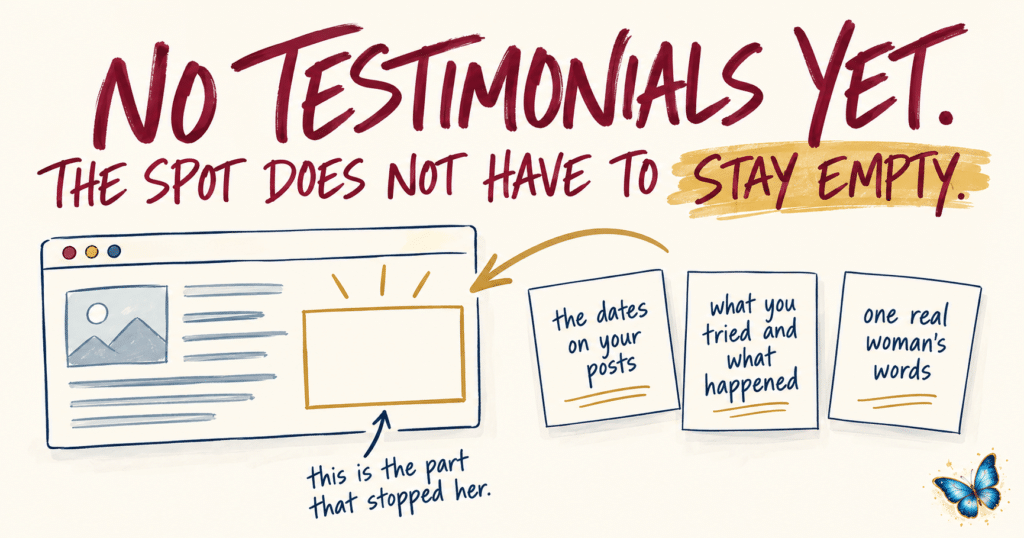
No testimonials yet is not the problem it feels like. A testimonial is a result rather than a requirement, so needing one before you launch means finishing before you begin. What goes in that empty spot instead is proof you already own, like your dated archive, your own numbers, and the questions readers keep bringing you.
There is a moment that stops a woman cold, and it comes when she gets to the part of the page where the proof is supposed to go. The place where other people have a row of smiling faces and a quote about how working with them changed everything.
She has nothing to put there.
Every piece of advice she finds tells her to ask her clients. She does not have clients. That is the entire reason she is sitting there trying to make the page look like it belongs to somebody worth hiring.
The next three days show you how to talk to AI using your own story, so what comes back sounds like you.
Why Every Guide to Getting Testimonials Is Written for Somebody Else
Search this and you get page after page of how to request a testimonial, what questions to send, which email template converts best. All of it assumes a finished transaction with a happy person on the other end of it.
If you had that, you would not be looking up what to do with no testimonials yet.
What nobody writes is the version for a woman who is six months into building something around a full time job, who has a blog with a few dozen posts on it, maybe a handful of people on a list, and no case study to her name.
That woman is not short on proof. She is short on the one kind of proof she has been told to look for.
What do you put on your website if you have no testimonials yet?
Put the proof you already own that does the same job. The dates on your archive, which show you did not quit. A result of your own, with real figures rather than borrowed ones. The question readers keep bringing you, which proves this is your subject. None of those need a client, and every one of them is harder to fake than a quote, which is why no testimonials yet is a much smaller problem than it feels like.
Why a Borrowed Title Costs More Than an Empty Spot on Your Page
There is a shortcut sitting right there, and it is worth talking about before we get to the useful part.
When you have nothing to show, the fastest way to look credible is to take a title that sounds like somebody already vouched for you. Coach, or strategist, or consultant, or expert.
A title makes two claims for you without you having to say either one out loud. That somebody trained you, and that somebody paid you. That is exactly why it is tempting.
I wrote about this somewhere else recently and it got away from me. Ten thousand people read it and thirty of them argued about it in the comments, so I know I am not the only one this bothers.
The line itself is simpler than the argument people have about it.
Writing about what you have lived through is true. Taking a title that implies credentials you do not have is not. The first one is about what you have done. The second one is about what you are, and those are two very different claims to be making. It is the same principle the FTC applies to endorsements, which is that what somebody says about you has to be what she actually believes, and the same standard is worth holding yourself to about what you say about yourself.
Your reader cannot always name the difference, and she can feel it. The woman who finds out later is the one who was going to buy from you.
Which is why a borrowed title costs you more than an empty spot on your page. An empty spot is just a gap, and a gap fills in the first time a real person tells you what working with you was like. A title you have not earned is a promise, and you have to keep making good on it every time a woman takes you up on it.
If what is holding you back is feeling unqualified rather than feeling unproven, that is a different problem with a different answer, and it is the one I wrote about in blogging without being an expert.
Five Kinds of Proof You Already Have When You Have No Testimonials Yet
Five of them, and not one requires a client.
The record itself. A year of posts with dates on them is evidence. Not evidence that you are brilliant, evidence that you did not quit, and a woman deciding whether to trust you is weighing exactly that. Anybody can write one impressive page. Almost nobody keeps going for a year, which is why the archive is worth more than the best single post in it.
The work, shown rather than described. There is a difference between telling her you know how to do something and walking her through you doing it. Show her the draft half built, or the version that did not work sitting next to the version that did, or the numbers from your own attempt rather than numbers out of somebody else’s case study. None of that needs permission from anybody.
Your own results, stated exactly. Not that you understand email marketing, but that you sent nine emails last month and what came back. Specificity is what reads as true, because the people making it up always stay vague. Vague is safe and vague is also the tell.
The conversations. Every question a reader has taken the trouble to type out is evidence that people come to you with this subject. Comments, replies, the message that arrived at ten at night. You do not need to quote anybody by name to say that this is the question that keeps arriving.
The change of mind. This one surprises people. Publishing what you got wrong and what you now think instead reads as more trustworthy than a wall of praise, because it proves you are paying attention rather than performing, and because nobody bothers to fake an admission.
All five of those get stronger the longer your archive runs, which is one more reason the posts you already have are worth going back to rather than leaving behind.
How do you build trust with no testimonials yet?
You show the work instead of describing it, and you do it on a schedule long enough that somebody notices. Dates on an archive, specific numbers from your own attempts, and a record of what you have changed your mind about all do the job a quote would do, and a reader weighs them the same way. Trust is built by being seen repeatedly rather than by being vouched for once.
Who to Ask for a Testimonial When You Have No Clients
None of that means you stop asking. It means you stop asking the wrong people.
Anybody who replied to one of your emails and told you something landed. Anybody who asked you a question and came back later to say what happened when they tried it. Anybody you helped before you ever charged for anything, which is most of us in the first year. The first person who bought anything from you at any price.
What you ask for matters more than who you ask. Do not ask for a testimonial, because the word makes people freeze and write something formal and useless. Ask what they were stuck on before, and what changed after, and what they would tell a woman who was trying to decide.
Three questions, and you will get something a reader believes, because it sounds like a person talking instead of a review.
Why a Small Audience Buys More Than a Large One
Somewhere along the way the goal became volume. Hundreds of leads, thousands of followers, a list that doubles every month.
You do not need any of that.
A small number of people who have been reading you long enough to know your name is worth more than a large number of strangers who landed on you once. The first group buys from you and tells their friends. The second group is a number you look at.
Chasing the big number is part of what sends women into borrowing in the first place. A crowd that does not know you needs to be convinced, and the shortcut to convincing a stranger is a credential. A woman who has been reading you for a year does not need convincing.
Getting that small group to recognize you starts with being clear about who you are for, which is the whole of narrowing your niche down.
Familiar is built on a rhythm, not on a burst
Being recognized is not something you can do in one good week. It comes from turning up in the same places, often enough and long enough that a woman starts to know your name before she needs you. That is a scheduling problem more than a writing problem, and it is the one that quietly defeats a woman building around a job.
The Content Map is the rhythm written down. One idea turned into a full week across Substack, LinkedIn, Facebook, Pinterest, email and search, with the Weekly Rhythm Checklist telling you which piece belongs to which day so you are never looking at the whole week at once. There is a walkthrough for every one of those places, and four chapters on training AI to sound like you rather than like a machine.
Thirty seven dollars, one time. Lifetime access and free updates as the platforms keep changing. Nothing downloads, so you log in and keep it open in one tab while your post sits in the other.
Why a Testimonial Is a Result Rather Than a Requirement
Something gets left out every time somebody tells you to go and collect testimonials.
A testimonial arrives afterward. After a woman worked with you, after it went well for her, after enough time passed that she could tell it went well. It is the result of work you have already done and already been paid for.
You have been told to have one before. Before you launch, before you charge, before the page goes up. That is being asked to finish something nobody has let you start yet.
Not having one is not a mark against you. It means you are early, and early is where every single person with a wall of them started.
Is it okay to launch with no testimonials yet?
Yes, and almost all of them did, including the women whose pages are covered in quotes today. A quote only exists after somebody has worked with you, so requiring one up front means requiring you to finish before you begin. Launch with the record, the work and your own numbers, and let the quotes arrive on their own schedule.
Why Old Testimonials Stop Working When Your Work Changes
Something worth telling you, because it cuts the other way.
I have a folder in my Google Drive full of testimonials collected over the years. Courses, trainings, blog posts, talks I gave on a stage. Real people saying real things about real work.
Almost none of it helps me now, which puts me closer to the woman with no testimonials yet than it looks.
They are about work I do not do anymore. Somebody praising a course I no longer sell does not tell a woman landing on my blog today whether I can help her get hers started. The quote is true and it is pointed at a version of me that is not the one she is looking at.
Which is the part worth sitting with if you are the one wishing you had a wall of them. The testimonial was never the thing that made somebody believe you, relevance was. A quote about the wrong version of you is as empty as no quote at all, and in one way it is worse, because it is loud about the wrong work.
There is a split in that folder, though, and it is worth knowing about before you go looking at your own old ones.
A testimonial about a deliverable dies with the deliverable. I have lovely words written about a LinkedIn course and a Twitter course I taught, and both of those stopped being useful the day I stopped teaching them. A testimonial about how you are to work with travels with you anywhere. She explains things in a way I could actually follow is still true, and it is still true about the blog.
If you have anything saved from an earlier version of yourself, read it with that in mind. The ones about what you are like are still yours to use. The ones about what you sold stay in the folder.
What to Put on Your Page When You Have No Testimonials Yet
Go back to the page you could not finish, the one with no testimonials yet sitting in the middle of it.
The first item that belongs in that empty spot is the record, written as a fact rather than as a claim. Writing about this since March, thirty one posts in, and these three are the ones to read first. She can see the dates and count the posts herself, which lands harder than any adjective you could put there.
Underneath it, one result you actually produced and what came of it, counted with your own figures and nobody else’s.
Then pick one person to ask. Somebody who replied to an email, or who asked you something and came back later to tell you what happened when she tried it. Send her the three questions. Whatever comes back goes on the page even if it runs two sentences, because two true sentences from a real woman beat a paragraph of polished nothing.
That fills the spot for now. Not forever, and not the way it will look in two years. It fills it this week, which is all it has to do.
If you want to know what the record you are building already says about you, go and check what AI thinks your business does.
Why Being Familiar Beats Being Famous
You are not trying to become famous. That was never the goal and it was never going to be what worked.
You are trying to become familiar.
Somewhere across those months, something happens that nobody warns you about. People start to recognize you. Not because you reached some finish line, but because they have been watching you do the work. They have learned how you think, what you believe, and what you are willing to change your mind about.
When somebody they know needs help with the subject you have spent years working out, your name is the one that comes up.
Maybe that is what building authority really looks like. Not becoming famous. Becoming familiar enough to be remembered.
A testimonial is somebody else telling her you are worth trusting. Familiarity is her working it out for herself, and what she decides on her own is the part that stays. No testimonials yet only means the quotes have not caught up to the work.
New around here? Start here and work forward.
Be unpolished,
Angela.