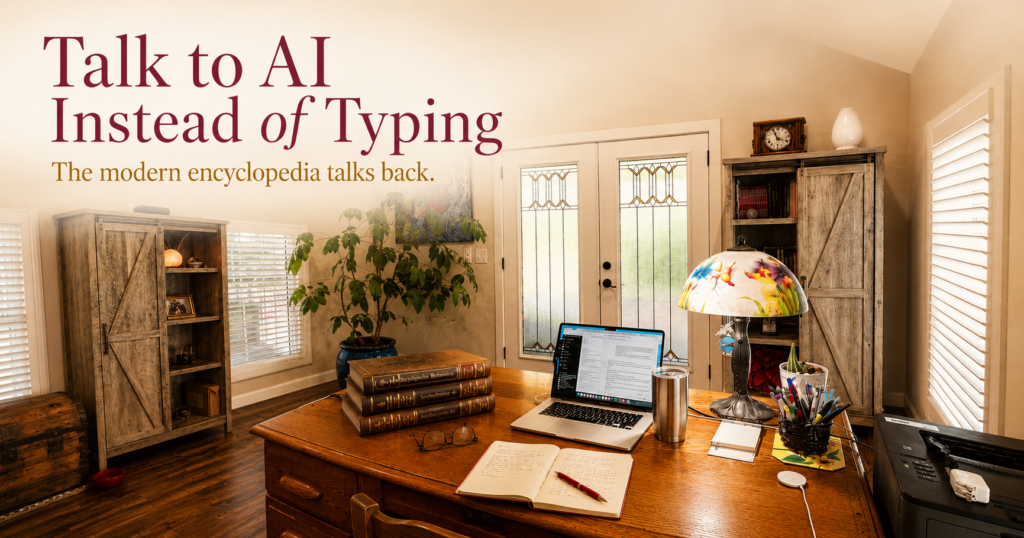
Back in school, a heavy encyclopedia sat on your desk. Your teacher handed it to you and said go research. If you raised your hand with a question, she said look it up yourself. So you dug through the pages alone, confused, trying to figure out what you were even looking for. Six pages, double spaced. And when you turned it in, the red pen marked it up. Not quite good enough. You still hear that the day you sit down to write, which is the real reason it helps to talk to AI instead of typing your way through a post alone.
That feeling stuck. Even now, when you sit down to write a blog post, you can still hear that voice. You think everything has to come out perfectly formed from your own brain, or you are not a real writer. You think that asking for help, even from a tool, means you were never good enough to do it on your own.
Here is what nobody told you. That teacher was wrong. And she gets proven wrong the moment you talk to AI instead of typing at it.
The research was never supposed to be punishment
I spent years believing I could not write, because one person told me I was not good enough. I kept my words in a private journal, locked away, sure nobody should ever read them. It took seventeen years of writing online before I understood the real problem. It was never my voice. It was that I was still trying to write the way that teacher wanted, perfectly formed, researched alone, with no questions allowed.
The research part of writing is what stops most people before they start. They sit down to a blank page, think I do not know what to write about, and walk away. That is not a writing problem. It is a research problem. You do not have the material yet. You do not have the depth. You do not have anyone to think it through with.
That is where Claude comes in. Not to write for you. To research with you.
Claude is the modern encyclopedia that talks back
Back when we were in school, the encyclopedia was the research tool. Heavy, cold, and yours to dig through alone. The teacher would not help you find what you were looking for. You just kept turning pages until something stuck.
Claude does that same job now. It goes deeper so your words can be real. The difference is that it talks back. You can ask it a question and get an answer. You can have a conversation instead of reading pages by yourself. And it happens in minutes instead of an afternoon lost in the stacks.
And somehow, using it still feels like cheating.
It is not cheating. It is the tool finally catching up to the job. The purpose never changed. Go deeper so your writing carries something real. The only thing that changed is that now you get to think out loud while you research, instead of suffering through it alone.
If you want the whole path laid out in the right order before you start, that is exactly what my free Start Here guide walks you through.
Building a blog around real life? Get the free Start Here guide — the steps, in order.
Why your drafts sound generic until you talk to AI instead of typing
When you type a prompt into a box, you are already editing yourself. You shorten your thoughts so they fit. You polish before you have even started thinking. By the time you hit enter, you have quietly deleted the messy parts, the half formed ideas, the contradictions, the wait, one more thing. And those messy parts are usually where the real insight was hiding.
AI answers what you give it. Hand it a tidy, trimmed down version of your thinking, and it gives you back the average of every tidy, trimmed down thought on the internet. That is why the draft sounds generic. It is not the tool failing you. It is that you edited your own thinking down to almost nothing before you ever fed it in.
Why does AI writing sound so generic?
AI writing sounds generic when you give it one tidy line and nothing else. With no detail about your reader, your opinion, or your real experience, it falls back on the average of everything online. Talk to it first, give it your specifics out loud, and the draft starts from your point of view instead of the internet’s.
What happens when you talk to AI instead of typing
The shift is small, and it changes everything. Open Claude or ChatGPT on your phone and tap the voice button, so you are actually speaking out loud. Talking changes how your brain works. You cannot edit in real time the way you do when you type. Your thoughts come out faster than you can police them. You wander, you interrupt yourself, you circle back to something you said a minute ago. That wandering is exactly where your real angle lives.
Here is the move almost nobody makes. Ask the AI to ask you questions before it writes a single word. Say it plainly. Before you help me, ask me five questions about my reader and what I actually believe about this topic, one at a time, and wait for my answer each time.
Then answer the way you would talk to a friend across the table, not the way you think a blog is supposed to sound. By the fourth or fifth answer, you will hear yourself say something you did not plan to say. You will land on a belief you did not know you had until it came out of your mouth. That is your angle. It was in you the whole time. You just needed something to ask you the right questions so you could hear yourself think.
Can you talk to AI instead of typing?
Yes. Most AI tools have a voice button that lets you speak and hear it answer back. When you talk to AI instead of typing, you think out loud, you include more context, and you stop trimming your ideas to fit a text box. The conversation hands the tool your real intent, so what comes back actually sounds like you.
The magic is in your voice
I have used Claude for a while, but what I only recently noticed is how few people are using the microphone. They are typing prompts. Waiting for answers. Hunting for the one magic prompt that fixes everything. They think the tool is the problem. It is not. The tool is doing exactly what it should. They are just not using it the way it was built to work.
When you talk to AI instead of typing, your brain moves at its real speed. You think the way people actually think, in tangents and reversals and sudden connections. You do not think in clean sentences. You think in real time, and that realness is what makes your angle yours instead of borrowed.
This post came out of a twenty minute conversation with Claude before I wrote the first word. The method is not a theory I am handing you from a distance. It is the exact thing I did to make the post you are reading. And once that conversation hands you your angle, turning it into a finished draft is its own skill, which I walked through in how to write a blog post with AI.
Try this with your own blog post right now
Do not wait until you finish reading. The whole point is that you feel it work.
Do this before you read any further
Open Claude or ChatGPT on your phone and tap the voice button. Say this out loud:
“I am writing a blog post about [your topic]. Before you help me, ask me five questions about my reader and what I believe about this, one at a time, and wait for my answer each time.”
Answer each one the way you would talk to a friend, not the way you think a blog is supposed to sound. By the last question you will catch yourself saying something you did not plan to say. That is your angle.
Then say: “Take everything I just told you and write the opening in my words, the way I said it.” Read it back. It sounds like you, because it came out of you.
What should I ask AI when my blog angle feels thin?
Ask it to interview you instead of you interviewing it. Say, ask me five questions about my reader and what I believe, one at a time. Answering out loud forces you to say what makes your take different. The tool then writes from your answers instead of the internet average, so the draft starts in your voice.
You are allowed to use research tools
The red pen is gone. The teacher who said not good enough does not get to live in your head anymore. You are allowed to research. You are allowed to ask questions. You are allowed to talk your ideas out loud before you write them down. You are allowed to use every tool in front of you to pull the real depth out of what you already know.
Claude is not stealing your voice. It is helping you find it. The only difference between now and that heavy encyclopedia on your desk is that this time, when you ask a question, something finally answers. And protecting that voice once you find it is its own job, which is where I am headed next in how to keep your voice when you write with AI.
Is it cheating to talk to AI instead of typing your research?
No. Using AI to research is no different than using an encyclopedia, a library, or a search engine. The work is still yours. You decide the angle, the opinion, and the words that matter. AI just gathers and organizes faster, so you can spend your energy thinking deeper instead of digging blind.
The one thing to do tonight
I have spent seventeen years watching people sit in a room and take notes on the one thing they can go home and try that night. The ones who get a result are never the ones who gathered the most information. They are the ones who walked out with a single thing to do, and then actually did it. This is your single thing. Have the conversation before you write. Stop silencing your voice by editing it before it ever reaches the page. Let the microphone make you think out loud.
When you are ready to build a whole system around this, where every post knows its job and quietly feeds the next one, that is what the Content Map is for. You do not need it to start. You need ten minutes and the voice button. But when you want the map, it is right here.
Be unpolished,
Angela.
If you want to try this alongside someone working on the same thing, the weekly letter goes out every Tuesday.