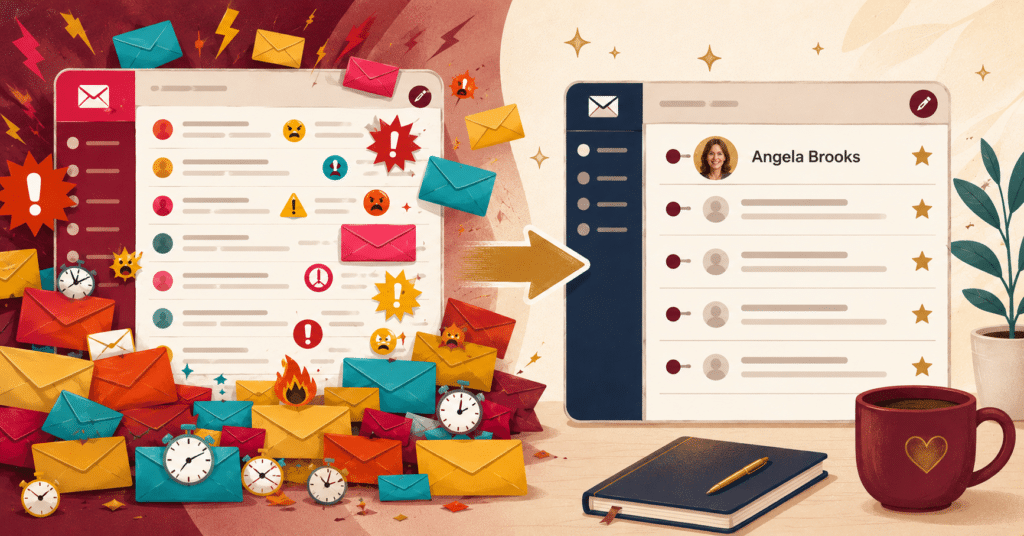
She opens because of your name, not your subject line
Here’s the thing nobody selling you subject-line tricks wants to admit. The subject lines that get opened aren’t the clever ones. When your reader glances at her inbox, the first thing she reads isn’t your subject line at all. It’s your name. She decides whether to open based on who it’s from, long before she reads what it’s about. If she trusts the name, a plain subject line still gets opened. If she doesn’t, the cleverest line you ever wrote gets scrolled right past.
That changes everything about how you should think about this. You’ve been sweating the subject line like it’s the whole game, when it’s really the last inch. The mile is your name and what it’s come to mean in her inbox. Every email you’ve ever sent her built that, or chipped away at it. The subject line just decides whether the trust you already earned turns into an open today.
If your opens are low, the fix usually isn’t a better formula. It’s becoming someone she’s glad to hear from. We covered how to be that person in the last few posts. This one is about the last inch, the line itself, and why the subject lines that get opened are never the ones trying hardest to trick her.
Want to know what to send so your name earns the open? The Content Map lays out the whole path from a single email to a real offer, so every send builds trust instead of burning it. It’s the first paid step in building this the way I did.
Clickbait subject lines are killing your list
Let me say the thing everybody dances around. Clickbait works once and costs you everything after. It gets the open, sure. Then she reads the email, realizes the subject line lied to her, and something quietly shifts. Next time your name shows up, she remembers being tricked. You didn’t win an open. You spent trust you can’t easily get back.
And she knows every move, because her inbox is full of them. Let me name them out loud, because you’ve been on the receiving end of all of these and they make your jaw tighten every time.
The fake countdown. “Only hours left!” when there was never a deadline, and there’s another “final chance” next Tuesday. She’s seen the same last-chance email from you four times. The clock means nothing now, and neither do you.
The withheld payoff. “You won’t believe what happened next…” and then the email makes her dig for a point that never really lands. She feels the bait-and-switch in her gut. You made her click for nothing.
The fake curiosity gap. “This one thing changed everything for me.” What thing? She opens, and it’s a vague story with no actual answer, just a link to buy at the bottom. That’s not intrigue. That’s a trap with a bow on it.
The manufactured panic. “Are you making this terrible mistake?” designed to spike a little fear so she clicks before she thinks. She’s tired of being scared into opening things. It’s manipulative, and on some level she knows it.
The fake scarcity. “Almost sold out!” on a digital product that can never sell out. She’s not stupid. The second she catches you inflating urgency that doesn’t exist, every real deadline you ever send lands as a lie too.
Here’s what all five have in common. They treat her like a mark instead of a person. They win the click and lose the human. And your whole business depends on that human trusting your name enough to open the next one.
Why does clickbait stop working?
Because trust only breaks once. The first misleading subject line might get the open, but the reader remembers the letdown, and the next time your name appears, she braces instead of leans in. Clickbait borrows against a trust account you can’t easily refill. A few withdrawals and the account’s empty, no matter how good the next line is.
What a subject line is actually supposed to do
Its job is simple, and it’s the opposite of a trick. Subject lines that get opened tell the truth about what’s inside, clearly enough that the right person wants in. That’s it. It’s a promise, and the email keeps it. When the subject line and the email match, the open turns into a read, and the read turns into trust, and the trust is what gets the next one opened. The data backs this up too, since email still returns more per dollar than almost any other channel, but only when people actually open and read it.
Clear beats clever almost every time. “The email I wish I’d sent my first subscriber” will out-open “game-changing secret inside” for one reason: it sounds like a real person telling the truth, and truth is rare enough in an inbox that it stands out. You don’t have to be witty. You have to be honest about what she’s about to get.
How do you write subject lines that get opened?
Say what the email actually gives her, in the plainest words that still make her curious. Subject lines that get opened name the specific problem the email solves, or the exact thing she’ll walk away with. Skip the hype, skip the fake stakes, and write it like you’re telling one friend what you’re about to help her with. If you can’t write an honest subject line for an email, the email probably doesn’t have a clear enough point yet, and that’s the real thing to fix.
The rule under all of it
Same rule that’s run under this whole series. Every email is a promise, and the subject line is where you make it. Keep it, and her trust grows and your opens climb on their own. Break it with a trick, and you win today’s click and lose the thing that was actually building your business. Subject lines that get opened come from being worth opening. There’s no formula that beats that, and there never was.
Not sure your emails are earning the open yet? Start by living inside one that does. The Three-Day Mirror is my own, and it shows you exactly how it feels to send something worth trusting. It costs nothing.