You have been writing for months now. Your posts are good. Google is finally starting to notice you, the traffic is creeping up, and you have done everything the way you were told to do it. So you open your dashboard expecting to finally see some money, and it is still sitting near zero. And the quiet question underneath all of it is the one you have not said out loud yet. When does the first year blogger income actually arrive, and am I doing something wrong if it has not?
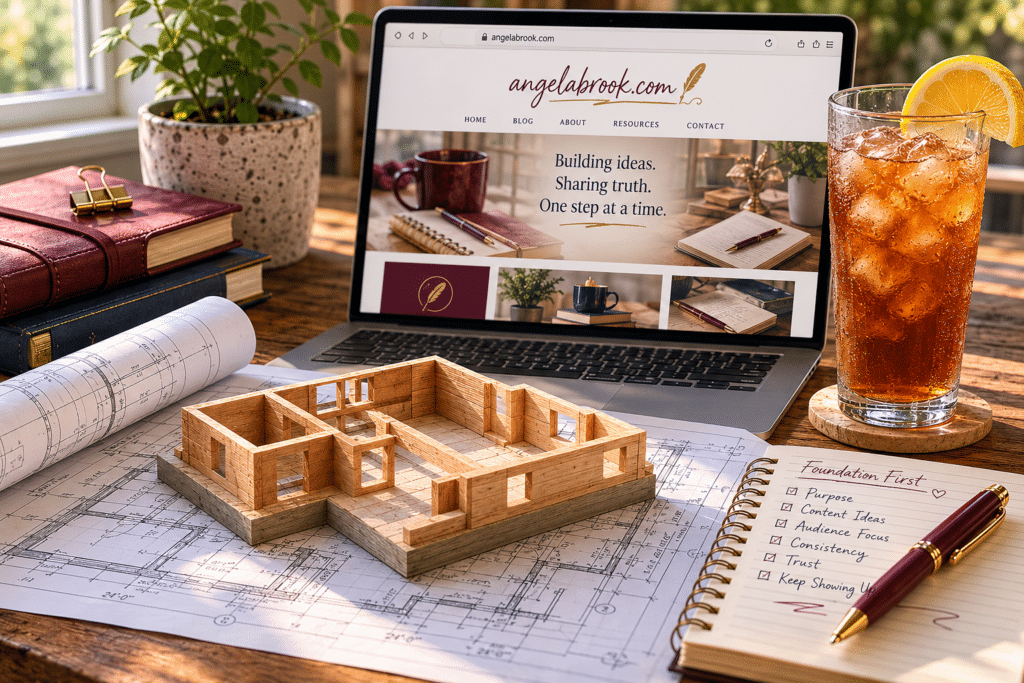
You are not doing anything wrong. You are measuring the wrong thing. Your first year blogger income is not the scoreboard in year one, the foundation is. A blog in its first year is not a money machine. It is online real estate you are building from the ground up, and real estate does not pay you the week you pour the foundation. It pays you for years once the structure is sound. The truth about first year blogger income is that it is a lagging result, not a leading one.
This matters because the women who quit in year one almost never quit because the work was wrong. They quit because they were grading a foundation by a scoreboard that does not turn on until later. They treated a quiet first year blogger income as proof of failure when it was actually proof the foundation was still being poured.
Your First Year Blogger Income Is Not a Money Machine. It Is Your Online Real Estate.
Think about what happens when someone builds a house. Nobody stands in the dirt on day one, looks at the poured concrete, and decides the project failed because no one is living there yet. They understand that the foundation comes first, then the framing, then the walls, then the roof. Only much later does anyone move in and call it home. A blog works the same way. The early months are the foundation. They do not look like income because they are not supposed to be income yet.
I have been Angela Brooks in this space for a long time. 17 years of digital marketing and a former career as a retired mental health nurse taught me one thing above all. Watch what actually holds up over time instead of what looks impressive in the moment. The women I have watched build real income from blogging all did the same unglamorous thing first. They built the foundation before they expected the house to pay them. The ones who quit were almost always standing in the concrete, frustrated that nobody had moved in yet.
Owning your blog matters more than almost anyone tells you. Social media is rented land. The reels and the posts you make there live on someone else’s property, and that property can change the rules overnight. Your blog is the one piece of digital real estate that belongs to you completely. It does not disappear when an algorithm shifts. It compounds quietly underneath you while you sleep, which is exactly why it is worth building correctly from the first post.
Why does first year blogger income take so long to arrive?
It takes time because a blog has to earn trust before it earns income. Google has to crawl your site, index your pages, and decide you are credible on your topic. A 2025 Ahrefs study of one million URLs found only 1.74 percent of new pages rank in the top 10 within a year.
Why Year One Has to Be About Building, Not Earning
Here is the part almost nobody explains, because most people teaching blogging never learned it themselves. Your blog has to be written for three different readers at the same time, and year one is when you learn to do that well. You write for Google, so your content can be found through search. You write for AI, so your content gets pulled into the answers that tools like ChatGPT and Google’s AI Overviews now generate. Those tools hand people answers before they ever click a link. And you write for the actual human on the other side, so that when she lands on your page, she stays.
That is what SEO and AEO actually are. SEO is search engine optimization, the practice of structuring your writing so search engines can find it and serve it. AEO is answer engine optimization, the newer practice of structuring your writing so AI systems recognize it as clear and trustworthy enough to cite. Most women starting a blog have never heard of the second one, and that gap is exactly why their content stays invisible while someone else’s gets found. If you want the full breakdown of how these two work together, I wrote a whole piece on what SEO and AEO actually fix when your blog stops getting traffic. Year one is when you build these skills into the bones of your site, not as an afterthought you bolt on later.
Do you really need to write for AI and not just Google?
Yes. People now get answers from AI tools before they ever click a search result, so content written only for Google misses a growing share of readers. Writing for both means structuring posts in clear questions and direct answers that AI systems can pull and cite. That puts you in front of people no matter how they search.
None of this pays immediately, and that is the point that gets lost in every conversation about first year blogger income. A foundation built for search and for AI and for a real human reader is a foundation that keeps working for years. The post you write this month, structured correctly, can still be sending you traffic and leads three years from now without you touching it again. That is the compounding nobody sees in month three because the compounding has barely started.
What should you focus on when your first year blogger income is still flat?
Focus on the foundation, not the dashboard. Publish consistently so Google has enough to index. Structure every post for both search and AI so your content can be found and cited. Pick a topic narrow enough that you become the recognized source on it. Income follows a foundation built right, not effort with no structure underneath it.
Content Stacking Is How One Piece of Work Compounds Into Everything
A woman told me yesterday that she makes ten reels a day and posts them across social media. Ten of them, every single day. I want you to sit with how much work that is, and then I want you to hear the part that matters. Every one of those reels lives for a day and then disappears into a feed that forgets it existed by morning. She is pouring an enormous amount of effort into rented land that gives her nothing back the next day. If that exhaustion sounds familiar, I walked through the alternative in how to get blog traffic without posting on social media every single day.
Now imagine she took those same reels and stacked them onto a blog. One strong blog post becomes the anchor. That post becomes a Substack article. It becomes a LinkedIn piece. It becomes a series of Facebook posts. It becomes Pinterest pins that keep getting found for months. It becomes an email to her list. One piece of real work, written once, distributed across every platform, all of it pointing back to the blog she owns. That is content stacking, and it is the difference between working harder every single day and building something that compounds.
How do you leverage one blog post across multiple platforms?
The blog is the foundation that makes the stacking work. Without it, every reel is a one-day event. With it, every reel becomes a permanent part of an asset that grows. That asset is what eventually turns a flat first year blogger income into something that pays you on its own. This is the exact system the Content Map walks you through, because the stacking is not random. It has a rhythm, and the rhythm is what turns scattered effort into a foundation that holds.
You write one strong blog post as the anchor. Then you adapt it into a Substack article, a LinkedIn piece, several Facebook posts, Pinterest pins, and an email, with every version pointing back to the blog you own. The blog holds the foundation. The other platforms are the amplifier. One piece of work does the job of ten.
The One Thing the Foundation Cannot Replace
There is one honest piece I will not skip, because skipping it is how women end up disappointed. A foundation built perfectly for search, for AI, and for stacking will bring you visibility and traffic and an audience that trusts you. It will not, on its own, hand you income. Income requires that you have something to offer the people who show up. A product, a service, an offer, something they can actually say yes to. The blog brings the right people to the door. What you are selling is what turns the visit into income.
This is why so many women feel stuck at the end of year one and decide their first year blogger income proves the blog failed. The foundation is working. The traffic is real. But there is nothing for the traffic to buy, so the income stays flat and they assume the blog failed. The blog did not fail. The foundation did its job. The missing piece was an offer, and an offer is something you can add the moment the foundation is ready to support it.
Unpolished Take on Year One
You are building online real estate. That is a slower, quieter, more honest thing than a money machine, and it is also the only version of this that lasts. The women earning real income from their blogs today spent their first year doing exactly what you are doing right now. They treated a flat first year blogger income as the cost of building a foundation that did not pay them yet. They did not have a secret. They had patience and a structure. The structure is learnable. The patience is the part only you can bring.
If you have been building for months, you may want someone to look at your actual foundation. You want to know whether it is structured to compound or whether something is quietly missing. That is exactly what a 45-Minute Business Audit is for. I look at what you have built and tell you what is working and what is not. Then I tell you whether your foundation is ready for an offer or still needs shoring up first. You can book your audit here.
And if you just want to follow along while you build, the newsletter is the open door. One email a week, the real version of how this foundation gets built, no pressure. You can join the newsletter here.
Be unpolished, Angela.
A first year rarely looks like the screenshots people post, and I went further into what actually moves during that stretch in can a blog really pay you.