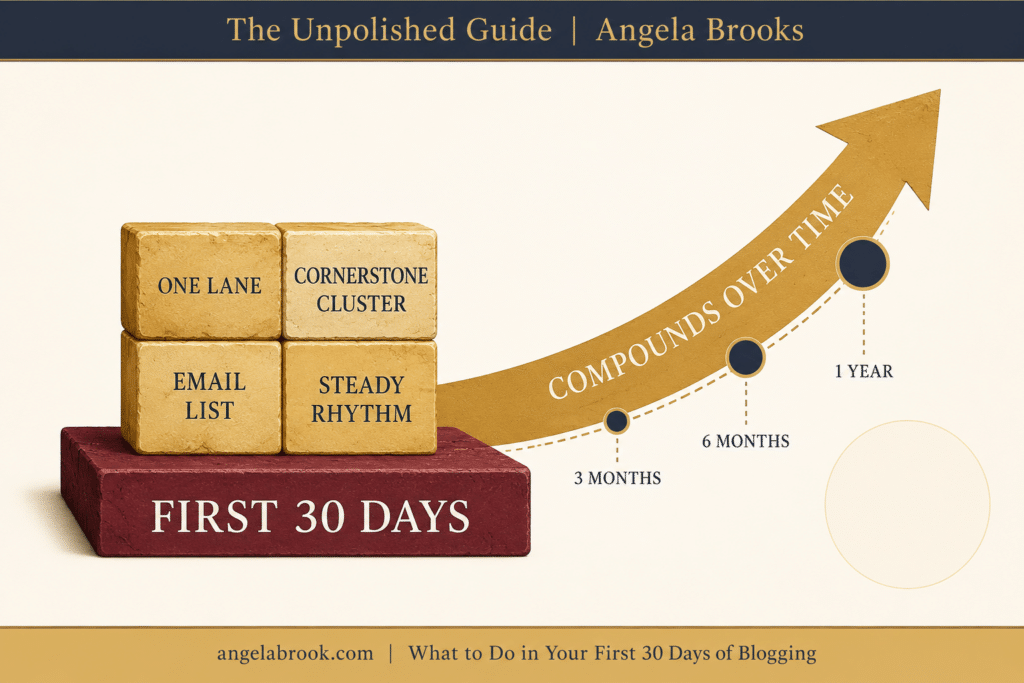
Your blog is live, the cursor is blinking, and you have no real idea what you are supposed to do with your first 30 days of blogging. Everyone told you to start. Almost nobody told you what the first month is actually for. So here is the answer before anything else: your first 30 days are not about traffic and they are not about income. They are about building a foundation small enough to finish and strong enough to hold everything you add later.
Here is what happens to most people, and it is the quiet reason so many good writers walk away. The first month feels like nothing. You publish, you check the numbers, the numbers barely move. You do it again. Then somewhere around month three or four, when the work still has not paid off the way you pictured it would, that is the moment most people quietly close the tab for good. Not because the plan was wrong. Because the first 30 days were spent on the wrong things, and by the time the wall shows up there is nothing underneath them to stand on.
A blog does not pay you for a single post. It pays you for a body of work that connects.
The whole point of your first 30 days of blogging is to decide whether you are building that body of work or just adding to a pile.
What You Actually Do in Your First 30 Days of Blogging
None of this is about setting the blog up. You already did the technical part. This is about where you point your hands once the thing exists. Your first 30 days come down to four moves, and not one of them is “post more.”
The first move is to pick one lane, and the way you find it is simpler than people make it. Think about the question people already bring to you, or the thing you catch yourself explaining over and over. That is usually your lane, because you can talk about it for a year without running dry. Then do one check before you commit. Type it into Google the way a real person would and make sure other people are actually searching for it. If you can picture the exact woman typing that question at ten at night, you have your lane. Pick it and stop shopping for a better one.
The second move is to build a starter cluster, not a calendar full of scattered posts. Here is the exact shape. Write one anchor post that answers the big question of your lane in full, the kind of post you would want to land on if you searched it yourself. Then write three shorter posts that each answer one question a reader asks right after the big one. Link all three back up to the anchor, and link them across to each other. That is the whole thing. One anchor and three supporting posts, all talking to each other. Four connected posts will outrank forty that stand alone, because search engines and AI read those links as a sign you actually own this topic.
The third move is to open one email door, and it does not need to be fancy. You do not need a polished freebie in your first month. You need an account, one signup form on your site, and one honest reason to join, even if that reason is simply that you send one good email a week. I use and recommend AWeber for this when you are starting out, because it is the simplest place to get a form live without fighting the tech. Get the door open now, before you have traffic, so the first real reader who shows up has somewhere to go instead of quietly slipping away.
The fourth move is to set a pace built for your worst week, not your best one. Most people pick a schedule that works the week they are excited and breaks the week life gets loud. Flip it. Choose the number you could still hit on a hard week, even if that is one post every seven days. Then write two at a time when you have the room, so a rough week pulls from your backlog instead of breaking the chain. The writer who publishes one solid post a week for a year passes the one who wrote ten in a single stretch and then went quiet.
How many posts should you publish in your first 30 days of blogging?
Three to five solid posts beat fifteen rushed ones. Depth wins in your first 30 days of blogging. A handful of cornerstone pieces that fully answer one question and link to each other will rank and compound far better than a wall of thin posts you wrote just to fill a calendar that nobody is grading.
What should you focus on first, traffic or content?
Content, every time. Traffic is the result of content built to be found and built to connect, not the goal you chase directly. In month one, hunting for traffic pulls you toward gimmicks and platform games that burn the little time you have. Building real, searchable, linked content is the only thing that pays you back later, quietly and on repeat. You can watch which of those posts start getting found inside a free tool like Google Search Console, which shows you the exact searches bringing people in.
Do you need an email list in your first month of blogging?
Yes, even if only a handful of people ever join it. The email list is the one piece you fully own. Set up a simple way to collect addresses in your first month, before you have traffic, so that when readers do start to arrive you can keep them and keep talking to them instead of hoping they find their way back on their own.
How do you know if your first 30 days are working?
You will not know by your traffic, and that is the part that trips people up. In month one you measure whether you finished what you set out to build. Four connected posts published. One topic held. One email door open. If those three things exist at day 30, the foundation is real, and traffic is a later conversation.
I have been building online since 2008, and the honest part nobody likes to hear is that the work I did in my own early months looked like nothing while I was doing it. I have a post I wrote back in 2012 that still sits near the top of Google and gets read every single day, and I have not touched it in years. It does that because it was built to connect from the start. Not because I wrote more, and not because I wrote faster.
If your first 30 days feel slow, that is not a sign you are behind. It is a sign you are early, and early is a good place to stand when you are building something meant to last. The women who make this work are not the ones who do the most in month one. They are the ones who build the right small thing and then let it grow into the rest.
When you are ready to see how one post turns into a system that feeds you instead of a thing you constantly have to feed, that is exactly what the Content Map lays out for you, one article built to live across six platforms and point every reader back to what you own.
And if you would rather walk alongside me while you build it, the newsletter is where I pull the curtain back every week and show you how the foundation actually comes together, piece by piece.
Be unpolished, Angela.
Everything in those thirty days sits inside a longer sequence, and the start here page shows you where the month fits.