You can edit your own book, even when it started as rough blog posts you wrote years ago. I just did it with mine, and the changes that mattered most had very little to do with grammar.01
My stories were written the night of each shift, more than twenty years ago, in the same words I would use out loud. Turning them into chapters meant moving them out of that night, protecting the people in them, and keeping my voice while making them easier to read.
In three days I will show you how to talk to AI so your stories come out sounding like you, not like a machine.
When you edit your own book, move every post out of the moment it was written
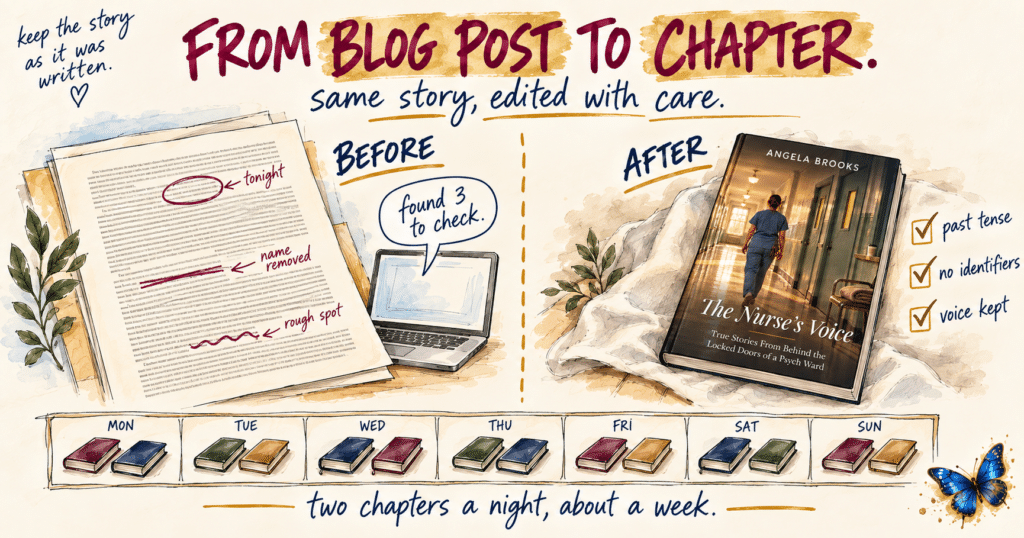
I wrote my stories the night of each shift, so many of them spoke as if the shift were still happening. Words like “tonight” and “last night” made sense on a blog, where a reader saw the post the next morning.
By the time I rewrote the book, I had been retired for twelve years, and the stories were twenty to twenty-five years old. Reading them as if they happened last night would have confused anyone picking up the book today.
Look for every word that ties a post to the day you published it. That includes “this week,” “yesterday,” “right now” and any mention of a season, a news event or a comment a reader left.
Take out every identifier, even the small ones that feel harmless
The biggest job in my rewrite was removing identifiers. I took out every detail that could point to where I worked, and I made sure no line could be read the wrong way about how someone was treated.
The setting was often aggressive and dangerous, and I wanted the stories to read with care rather than leave a reader with the wrong picture. A blog post can slip by without much notice, while a book gets read closely, passed along and kept.
Your posts may not carry the same risk, but most blogs still hold names, places, workplaces and family details that were fine to share online at the time. Check each chapter for them before it goes into print.
Writing the way you talk reads rougher on a page than it did on a blog
I wrote those posts exactly the way I speak, and on a blog that worked. In a book, the same stories read rougher than they needed to, and some were hard for a lot of people to get through.
The second edition made better word choices and softened the hardest stories without changing what happened. Your voice should stay in every chapter, while the stumbles that slip past in a quick read online get smoothed out.
One way to find those stumbles is to read a chapter out loud, or have your computer read it to you. IngramSpark puts reading out loud near the top of its tips for editing a manuscript without an editor, because a sentence that makes you trip when you hear it will make your reader trip too.
Can you edit a book yourself?
Yes, you can edit your own book, especially one built from blog posts you already know well. Work in small sittings, read chapters out loud, and use a checklist so you catch the same kinds of problems in every chapter. A second set of eyes still helps, as long as that reader is willing to tell you what needs to change.
AI can help you edit your own book, and it beat the editing on my first edition
I used AI heavily for this rewrite, and it did a better job than the editing on my first edition, which left the book rawer than it had to be. The most useful work it did was checking for repeated stories and phrases, and for any detail that could lead back to the place I worked.
I would read a couple of chapters, take a break, then come back and ask AI to look for one specific problem before reading more. Asking it one clear question at a time worked better than asking it to fix the whole chapter at once, and you can start with a prompt like this one:
“This chapter started as a blog post. Without rewriting it in your own words, point out any word that ties it to the day I wrote it, any name or detail that could identify a real person or place, any phrase I repeat from other chapters, and any sentence that reads rough out loud, and leave my voice as it is.”
Asking AI to point out problems, rather than rewrite them, keeps the chapter sounding like you. You decide each change, which is how you edit your own book without handing your voice to a machine.
Can you use AI to edit your book?
Yes. AI is good at catching what you have read too many times to notice, such as a story you told twice or a name you meant to take out, and it does not get tired by the last chapter. It can still miss what only you know, so check each suggestion against what really happened before you change a word.
Kind readers are not the same as editors
Even when you edit your own book, an outside reader helps.
Two people read my book before it went to print the first time. They were kind, and I think they were too kind, because neither of them suggested the changes it needed.
One of them told me she was making edits as she read, and when I look back at those notes now, they were messy and missed a lot. A friend who loves you is a wonderful first reader, and you will still want a sharper reader to catch what she does not want to point out.
Give each chapter a new title, because blog titles do a different job
When you edit your own book, give the chapters new names.
I wrote new chapter titles rather than keeping my blog post titles. A blog title is written to be found in a search, while a chapter title is read by someone already holding your book.
A chapter title can be shorter and warmer, and it can hint at the story without answering a question someone typed into Google.
Edit your own book in small sittings so tired eyes do not miss the mistakes
I read through my book on and off for about a week. I would read a couple of chapters, take a break, and come back later, so I was never tired enough to skim past a problem.
If you are working around a job and a family, two chapters an evening is plenty. A short book can be edited that way in a week or two without giving up a whole weekend. Once the editing is finished, the last step is to publish on Amazon KDP, and it is easier than it looks.
Keep the story as you wrote it, even when new memories come back
Rereading the stories brought back memories I wish I had put in the book. Over the years, though, the details of what happened fade, and I did not want to make up a single detail.
The stories in my book were written fresh after each shift, which is why I trust them. Updating what I wrote back then felt truer than adding events I could only half remember.
That is one of the quiet gifts of a blog. The posts you write today are a record of what happened while it is still clear, and they will be there when you are ready to turn them into chapters. If you are still choosing which posts to use, start with how to organize blog posts into a book.
Every post you publish now adds to that record, and building a blog that compounds over time is how the record grows into a book.
If you want to see what my night-shift posts became once they were edited this way, The Nurse’s Voice is the second edition, and the book page has a free chapter you can read first.
Every Tuesday I send an email sharing what I am building, along with the tools and ideas I use, and you can get that email here.
Be unpolished,
Angela