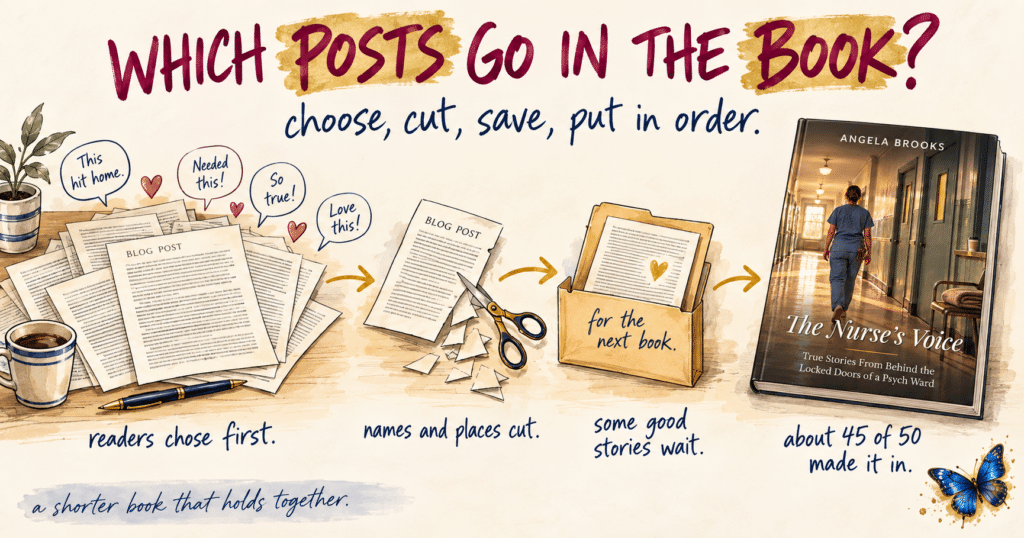
To organize blog posts into a book, start by choosing which posts belong, and the ones your readers answered most are the place to begin. From there you cut what does not serve the book, put what is left in an order a stranger can follow, and write the new pieces that connect them.
I have done this twice with the same set of night-shift posts, once years ago and again this fall for the second edition of my book. The choices I made each time are the clearest way I know to show you how to decide what stays.
Your best stories are already in your posts, and in three days I will show you how to talk to AI so they come out in your own words.
The posts your readers answered most come first when you organize blog posts into a book
When I put my first book together, I had written about fifty posts after coming home from shifts at a psychiatric hospital. Roughly forty-five of them made it into that first edition.
I chose them by the comments. The posts that drew the most replies from readers went in, and the ones that drew the fewest stayed out.
That turned out to be a good filter, because readers were telling me which stories they would carry with them. The nights with the most drama were the ones people wanted, and nearly all of those stayed in the book.
People do not comment on blogs the way they did back then. You can still find the same signal in the email replies you get after a post goes out, in the posts that keep getting visits months after you published them, and in the posts people share or ask you about.
How do you choose which blog posts go in a book?
Start with the posts your readers responded to most, since they already showed you what they want to keep reading. Then check that each one fits the single subject your book is about. A post can be popular and still belong in a different book, so the subject decides first and the response decides second.
Cut any post that points back to a real person or place, even a good one
When I rewrote the book this fall, I took out at least five more stories. I removed every name, every detail that could lead back to the hospital, and every detail that could point to the people I worked with.
I also cut language and situations that did not belong in a book I wanted to stand behind. People who know me would still recognize the stories, and that is fine, but a stranger who picks up the book has no way of tracing them to anyone.
A blog post can sit quietly in your archive for years, while a book gets sold, passed around and kept on a shelf. Before you organize blog posts into a book, read each one as if the person in it were reading over your shoulder, whether that is a client, a coworker or someone in your family.
Some good stories get left out when you organize blog posts into a book
There is one story I left out that I still wish were in there. We were helping a woman into the seclusion room so she could have the medication she needed to calm down, and she was someone who came in and out of the hospital often, so everyone on the unit knew how aggressive she could get.
I was very pregnant, and there were about six of us in that room. Once she was settled enough for me to give the shot, the only part of her still loose was one wrist, and as I leaned over her, her fingers flopped up toward me and she told me she was putting a curse on my baby.
We all laughed, partly from the stress of the moment and partly because it was so completely her. A friend saw the new edition just this week and asked me whether I had put that story in, and I had to tell her no.
You will have stories like that too, posts you love that do not quite fit the book you are building. Move them to a separate list rather than deleting them, because a story that does not fit this book may be exactly right for the next one.
Should every blog post go in the book?
No, and most books built from a blog leave a good share of posts behind. Keep the posts that serve one subject, cut the ones that repeat each other or point to real people, and save the ones you love but cannot fit. A shorter book that holds together reads better than a long one that wanders.
Keep the order you wrote them in unless another order helps your reader
Once you have chosen, the next decision when you organize blog posts into a book is the order.
My stories went into the book in roughly the order I wrote them, which was close to the order they happened. For a collection of true stories, that worked, because a reader moves through the nights the same way I lived them.
A how-to book usually needs a different order. If your posts teach a process, put them in the order your reader would do the steps, even if you wrote the last step first.
Writer’s Digest makes a point worth keeping in mind here. Their advice on turning a blog into a book warns against services that pull your posts directly into a book without editing, because blog posts read like a first draft once they sit side by side.
Do you need to write new material when you organize blog posts into a book?
Usually, yes, though often less than you expect. Most books need a new introduction and a few short pieces that carry the reader from one post to the next. When I rewrote my book, I wrote a new introduction from where I am now as a retiree looking back, which filled the gap between who wrote the stories and who is sharing them today.
AI can sort your posts for you in a few minutes
You do not have to read through every post to decide what stays when you organize blog posts into a book. Give AI your blog address and the subject of your book, and let it do the first sort with a prompt like this one:
“This is my blog: [your blog address]. Look at my posts about [your book’s subject]. Tell me which ones belong in a short book on that subject, which ones repeat each other, which ones mention real people or places I should think twice about, and what order would make sense for a reader starting at the beginning.”
Read its answer the way you would read advice from a friend, and keep the final choices yours. AI can count and sort, but only you know which story a reader still asks you about.
If you are not sure yet whether you have enough posts on one subject, start with how to tell if your posts are ready to become a book, then come back here to choose.
The posts you write this year can be organized into next year’s book
In April, I was not thinking about another book at all. Now, looking at the posts I have published here from April through October, I am planning my next one from them.
I want it to walk a woman through building her own creation, and to speak to her so directly that when she finishes, she feels like she sat across the table from me. The posts are already there, so the work ahead is to organize blog posts into a book the same way, choosing, cutting, ordering and filling in.
Once you know a book could come from your blog, every post you write gets a second job. A blog that compounds over time keeps earning attention while it builds toward a book, so it helps to ask, as you finish each post, whether it belongs in the book you are slowly collecting.
If you want to see what fifty night-shift posts turned into once they were chosen, cut and rewritten, The Nurse’s Voice is that book, and there is a free chapter on the book page if you want to read a little before you buy.
Every Tuesday I send an email sharing what I am building, along with the tools and ideas I use, and you can get that email here.
Be unpolished,
Angela