For a long time I believed the writing was the whole job. Write something good, hit publish, and the right people find it. What I did not know is that a blog that gets found runs on something underneath the words, and nobody ever showed me what it was.
I believed the writing was enough because I was told it, over and over, for years.
Then I watched good posts go quiet, and I stopped believing it.
The map behind a blog that gets found
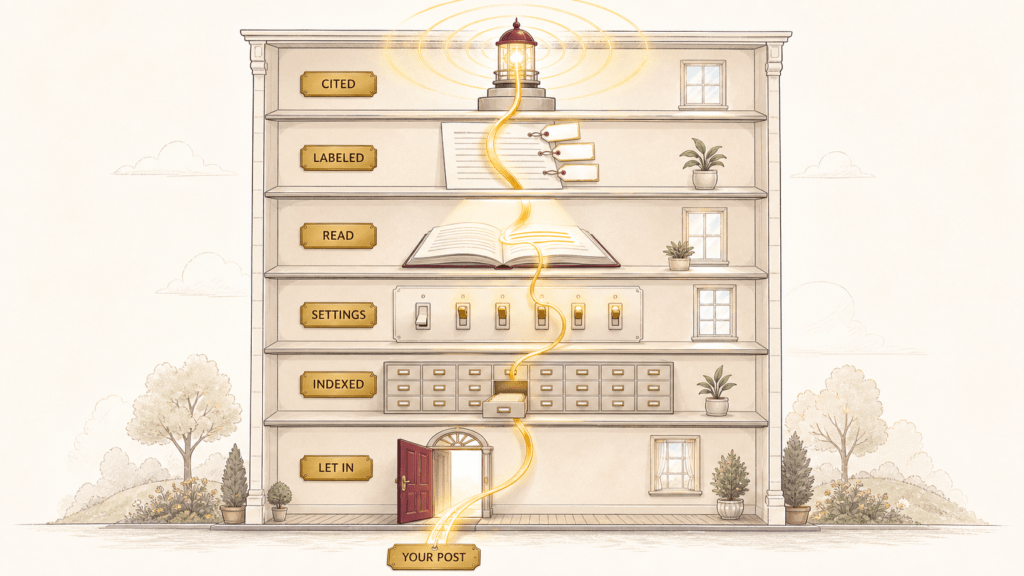
This month I took the whole thing apart to see what actually decides whether a blog gets found. It is not one fix you are missing. It is a sequence. A machine reads your blog in a certain order, and if it gets stopped anywhere along the way, everything past that point never gets seen.
This is the map I wish someone had handed me when I started blogging. Not another pile of tasks to keep up with, but a way to see how a blog that gets found actually fits together, so the work you do grows your blog instead of just filling your days.
I want to walk you through it the same way the machine moves through you, from the ground up.
What a blog that gets found is really made of
It starts at a door. Before a single reader or a single AI can find your writing, a crawler has to be let in, and that permission lives in a small file most bloggers have never opened. One stray line in it can quietly lock the whole site, and you would never know. That is the first place I looked, and I wrote down exactly how to check yours in Your Robots.txt Might Be Blocking Crawlers.
Getting through the door is not the same as getting put on the shelf. Even after a crawler is allowed in, Google still has to file your post before anyone can find it, and a new post can sit there unfiled longer than you would guess. If it is not indexed, it does not exist to be found, no matter how good it is. That is the next step down, in Indexing Speed: Why Your Blog Isn’t Found.
Once I understood the door and the shelf, I went looking for where those things are actually controlled, and most of it turned out to be sitting inside my plugins, half of them switched the wrong way straight out of the box. Nobody ever hands you that light switch. I found every one of them and laid them out in WordPress Plugins That Control AI Visibility.
Being let in, filed, and switched on still was not enough. AI could reach my post, read every word, and leave without quoting a line, because it could not find a clear answer where it expected one. That was the hardest thing to see, and the one that changed how I write. It is in How to Audit Your Blog for AI Readability.
There are also the tags wrapped around your words, the quiet labels that tell a machine who wrote this and what it is. Leave them blank, which is exactly how most of us leave them, and you have told the machine you have no name and no face. I walk through the whole thing without the jargon in Schema and Structured Data: Why AI Needs It.
The last part surprised me most, because it is not on your page at all. AI leans toward names it already knows, names it has run into in rooms you do not own. Your writing can be perfect and still get passed over for one it recognizes. That is the top of it, in Building Authority So AI Wants to Cite You.
Start by seeing where you stand
Every one of those is a reason a blog gets found or stays quiet. None of them tells you where you stand right now, today, before you change a single thing. That is where I would actually have you start. Go see what AI can and cannot find of you as you are in Is Your Blog Actually Visible to AI?, then walk back up this path fixing one thing at a time.
This week, take one post you are proud of and run it through that first check, so you can see what AI actually finds. That is the whole to-do. One post, ten minutes, and you will know which layer to fix first.
Questions bloggers ask about a blog that gets found
Why isn’t my blog showing up on Google?
Usually because Google has not indexed it yet, or something is blocking the crawler before it reads a word. A good post can sit invisible for weeks for a reason that has nothing to do with the writing. Check that you are allowed in and filed first.
How do I know if my blog is indexed?
Type site:yourblog.com into Google, or search the exact title in quotes. If nothing comes back, the post is not filed yet. Google Search Console shows it plainly under Pages, and you can ask it to index a new post right there in a couple of minutes.
How do I get my blog found by AI, not just Google?
Make sure AI can reach the post, read it cleanly, and lift a clear answer from it. That means being crawlable, giving each question a direct answer near the top, and filling in the labels that say who wrote it. AI has quietly become one of your biggest readers.
Do I need to write more posts to get found?
Not usually. When a blog goes quiet it is almost never a volume problem, it is one layer underneath the writing that is switched off or blocking you. Fix that layer and the posts you already have can start getting found, without adding a single new one.
Where should I start if my blog isn’t getting found?
Start by seeing where you stand before you change anything. Take one post you are proud of and check what Google and AI can actually find of it today. That one look tells you which layer is stopping you, so you fix the real thing instead of guessing.
Your next step
You just saw the whole path from the ground up. The Content Map is how you plan a post to clear every step of it before you publish, instead of hunting back through all of them after it goes quiet.
Get the Map, $37If this helped you see the machine a little clearer, the share buttons are right at the bottom of this post. Pass it to a blogger who keeps writing good posts into a quiet room.
Be unpolished,
Angela
Want the Tuesday letters?
One quiet note a week on building a blog that gets found. No noise, and you can leave anytime.
Get the Tuesday lettersThe full stack, in order
Every step above, one tap each. Start at the bottom and work up.
1. Your Robots.txt Might Be Blocking Crawlers 2. Indexing Speed: Why Your Blog Isn’t Found 3. WordPress Plugins That Control AI Visibility 4. How to Audit Your Blog for AI Readability 5. Schema and Structured Data: Why AI Needs It 6. Building Authority So AI Wants to Cite You Start here. Is Your Blog Actually Visible to AI?