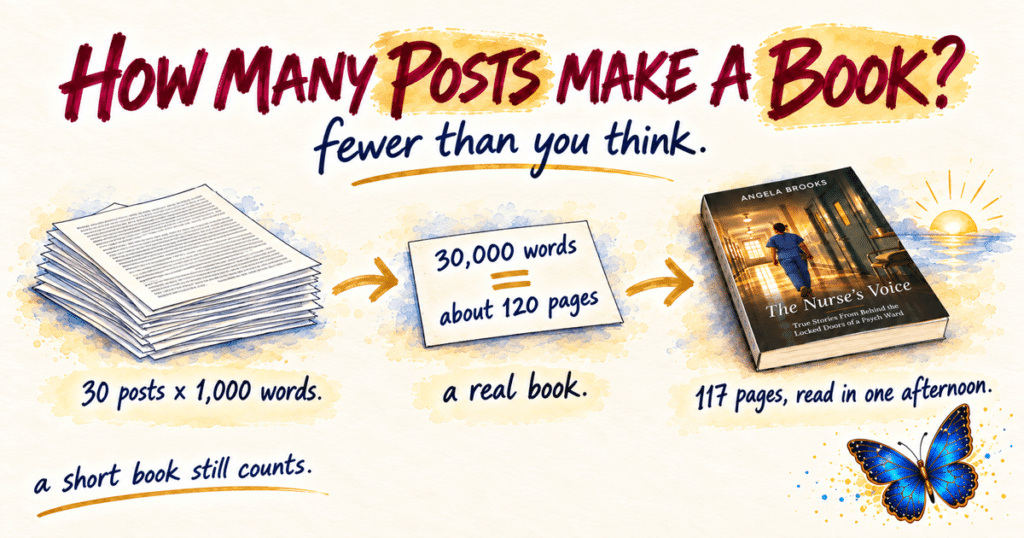
A short nonfiction book usually runs about 30,000 words, which prints to roughly 120 pages, so if your posts are around 1,000 words each, about thirty of them can make a book once you cut and fill in. Nonfiction book length for a full-length book runs closer to 50,000 to 80,000 words, which takes more posts, more new writing, or both.
My own book is 117 pages, and for a long time I did not believe that counted as a real book. If you are wondering whether your posts add up to enough, that is where I would start.
In three days I will show you how to talk to AI so the stories already in your posts come out in your own words.
Nonfiction book length starts around 30,000 words, which is about thirty blog posts
Publishers talk about books in words rather than pages, because the page count changes with the font, the spacing and the size of the book. A typical printed page holds somewhere around 250 words, and Kindlepreneur’s look at words per page puts the average for nonfiction a little lower, at about 233.
That makes the math simple enough to do on the back of an envelope. Thirty thousand words comes to roughly 120 printed pages, fifty thousand comes to roughly 200, and eighty thousand comes to roughly 320.
When people talk about nonfiction book length, short how-to books and focused guides tend to sit at the low end, somewhere between 20,000 and 50,000 words. Memoirs and deeply researched books run much longer, because they cover more ground.
Is 30,000 words enough for a nonfiction book?
Yes, for a short, focused book it is enough. Thirty thousand words prints to roughly 120 pages, which is a comfortable length for a guide or a collection of stories a reader can finish in a day or two. What matters more than the count is whether the book delivers what it promises without padding.
I thought a real book had to be thick, and 117 pages changed my mind
When I had about forty-five stories ready for my first book, I never felt like it was enough. In my mind, an author was someone who wrote a big novel, and a little book of a hundred or two hundred pages did not count as authorship.
I worried it was too thin, and I published it anyway. The second edition is 117 pages, which makes it a quick read.
Not long after it came out, a nurse sent me a message saying she sat down and read the whole book in one afternoon. She loved the stories, and because she was a nurse herself, they meant more to her than a longer book might have.
That message did more to settle my worry about nonfiction book length than any number could. A reader who finishes your book in an afternoon and writes to tell you about it got exactly what she came for.
Is a 200 page book too short?
No, a 200 page book sits right in the middle of a normal nonfiction book length, around 50,000 words. Even 100 to 150 pages works well for a focused how-to book or a collection of stories. A short book is only too short when it leaves out a step the reader needed to finish what she came to do.
A short book a reader finishes beats a long one she sets down
I have read short books I loved, and one of them was handed to me, signed, by a woman I once cared for as a nurse. I enjoy short books partly because I get distracted reading a long book, and I have not read a 300-page book in a very long time.
Your reader is probably a lot like that too. If she is working and caring for a family, a book she can finish over a couple of evenings has a better chance of being read, talked about and recommended than one that sits on her nightstand half done.
To work out your nonfiction book length, multiply your posts by their words
How many blog posts make a book depends on how long your posts run. You can see the word count for any post inside the WordPress editor, so check a few of yours and use the average.
- Posts around 500 words: about sixty posts for a 30,000-word book.
- Posts around 1,000 words: about thirty posts for a 30,000-word book, or fifty for a 50,000-word book.
- Posts around 1,500 words: about twenty posts for a 30,000-word book.
Those numbers are a starting point, because some of every post gets cut when it moves into a book. Most books also need a new introduction and a few short pieces that connect the posts, which usually makes up the difference.
I counted my own while writing this post. Since April I have published 97 posts here, and once I take out the question and answer sections, the signup boxes and the paragraphs that point to other people’s sites, my own writing comes to about 1,200 words a post, or roughly 120,000 words before any editing.
That is more than one full-length book with plenty left over, so my next one will be longer than The Nurse’s Voice and written for a different reader. For me, the work ahead is choosing what stays rather than finding enough.
Once you know roughly how many posts you have on one subject, choosing which ones belong in the book is the next step.
Page count also shapes what your book costs a reader
A paperback costs more to print as the page count climbs, so nonfiction book length plays into your price. When I priced my paperback, I looked at what similar books with about the same number of pages were selling for, and I kept mine in that range.
I did not want to overprice it, because I wanted sales and reviews more than a bigger cut on each copy. A shorter book at a fair price is easier for a stranger to say yes to.
What is a good nonfiction book length?
For most nonfiction, somewhere between 30,000 and 80,000 words, or about 120 to 320 printed pages. Short guides and story collections sit at the lower end, while memoirs and researched books run longer. Look at a few books your reader already buys and aim for a length that covers your subject without filler.
You probably have enough for a book sooner than you think
I never thought I had enough content, or content good enough, to write a book, much less to encourage anyone else to write one. Even so, we all have stories, and our lives are full of them.
Even when we do not think our stories are good or important, somebody out there will be helped by our words, even if we never learn who they are. If you are still deciding whether you have enough, start with how to tell if your posts are ready to become a book.
A blog that keeps adding a post or two a week is quietly building toward a book the whole time, and building a blog that compounds over time is where that starts.
If you want to see what 117 pages of night-shift stories looks like, The Nurse’s Voice is the book I almost talked myself out of publishing. The book page has a free chapter, so you can see how it reads first.
Every Tuesday I send an email sharing what I am building, along with the tools and ideas I use, and you can get that email here.
Be unpolished,
Angela