why is my blog not getting traffic — dot-com era vs AI-AEO era content strategy by Angela Brooks

Why Is My Blog Not Getting Traffic Anymore — What SEO and AEO Actually Fix

Your blog is not getting traffic and you have been doing everything you were told to do. You are writing. You are posting. You are putting content out on every platform you can manage between work and dinner and whatever else is sitting on your plate. And still, the numbers are flat or falling, and you are starting to wonder if you are doing something wrong.

You are not doing something wrong. The ground shifted underneath you — and most content creators did not get a warning.

This is the most important thing I can tell you about why your blog is not getting traffic right now: the way people search for information changed completely, and the content that was built for the old way is invisible in the new one. 

Understanding the difference between SEO and AEO is not optional anymore. It is the foundation that determines whether your content compounds over the next three years or disappears into a feed nobody scrolls to the bottom of.

What Actually Changed — And Why It Is Bigger Than the Dot-Com Era


When the internet became a commercial space in the late 1990s, businesses that did not pay attention to what was happening online lost ground fast. Some never recovered. The content creators who shrug at what is happening right now with AI search are making the same mistake — except the speed of this shift makes the dot-com era look slow.

The numbers are not subtle. Zero-click Google searches — meaning someone searches, gets an answer on the results page, and never clicks a single link — climbed from 56% of all searches in 2024 to 69% in 2025, and that number is still rising. ChatGPT now handles over a billion searches every week. Google’s AI Overviews reach 1.5 billion users monthly across 200 countries. The people who used to find your blog by typing a question into Google are now getting the answer before they ever see your link.

This is not a traffic problem you can solve by posting more often. It is a structural problem. And the content creators who build the right foundation right now — while the space is still open — are the ones who will be cited, found, and trusted when everyone else is scrambling to catch up.

Major publishers with full teams and decades of authority are already bleeding. Business Insider lost 55% of its organic search traffic between 2022 and 2025. HuffPost lost nearly half its search referrals over the same period. Chegg reported a 49% drop in traffic tied directly to AI Overviews answering the questions their entire business was built on. Those are not small operations. They are cautionary stories for every content creator who is still building on rented land and calling it a strategy.

Why is my blog losing traffic even though I am still posting regularly?

Your blog is losing traffic because the search landscape changed, not because your content is poor. AI Overviews, ChatGPT, and Perplexity now answer search questions directly on the results page, which means fewer people click through to any website. Organic click-through rates dropped 61% on queries where AI Overviews appear. Posting more frequently does not fix a structural visibility problem — optimizing for how AI reads and cites your content does.


What Rented Land Actually Means for Content Creators

If you are creating content only on social media platforms — Instagram, TikTok, Facebook, LinkedIn, wherever your audience currently lives — you are building on land you do not own. The algorithm changes. The platform changes its reach overnight. A policy shifts and your account is restricted. And every piece of content you spent hours creating disappears into a feed that forgets it existed by morning.

This is what rented land means. You are putting real work into a space that does not belong to you and cannot compound for you. The views, the followers, the engagement — none of it transfers when the platform moves the goalposts. And they always move the goalposts.

The content creators who will still be standing in three years are the ones who used social media as a door, not a destination. Every post, every reel, every LinkedIn update should be pointing somewhere you own — your blog, your email list, your Substack. Those are the three pieces of digital real estate that no platform can take from you. Your email list especially. It is the only traffic source that belongs to you completely, and it grows every time someone finds your content through search and decides they want more.

The Content Map was built on exactly this principle. It teaches you how to write one strong piece of content and distribute it across six platforms in a way that drives people back to what you own — so your work compounds instead of disappearing. You can see the full breakdown at https://angelabrook.com/Content-Map.

What does it mean to build on rented land as a content creator? Building on rented land means creating content exclusively on platforms you do not control — social media, third-party apps, or any space where the rules can change without notice. When algorithms shift or accounts get restricted, that content and audience can disappear overnight. Building on owned platforms like a blog, an email list, and a Substack gives your content a foundation that compounds over time and cannot be taken from you.


What SEO Is and What It Still Does

SEO — search engine optimization — is the practice of writing content in a way that search engines can find, understand, and serve to someone actively looking for what you wrote. It covers your focus keyword, your title structure, your meta description, how fast your page loads, and whether Google can crawl your site without hitting dead ends.

SEO is not dead. Anyone who tells you that is missing the point. What SEO does is give your content a technically sound foundation — and without that foundation, nothing else works. AI systems cannot cite what they cannot find. Google cannot rank what it cannot read. SEO is still the infrastructure that everything else runs on.

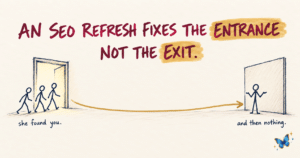
What changed is that SEO alone is no longer enough. Getting to page one used to mean someone would click your link. Now, even a first-page ranking does not guarantee a visit if an AI Overview answers the question above your result. Click-through rates drop from 15% to 8% the moment an AI Overview appears on a search page. Only 1% of searches lead to a user clicking a link inside an AI Overview at all. The traffic that used to come from ranking well is being intercepted before it reaches you — unless your content is the one being cited inside the answer.

Does SEO still matter for bloggers and content creators in 2026? Yes, SEO still matters in 2026 and it remains the foundation that makes everything else possible. Without solid SEO, your content cannot be found or indexed by AI systems at all. What changed is that SEO alone no longer guarantees traffic — because AI Overviews now answer queries before users click any link. Bloggers who understand both SEO and AEO are the ones whose content shows up regardless of how someone is searching.


What AEO Is and Why It Is the Piece Most Content Creators Are Missing

AEO — answer engine optimization — is the practice of structuring your content so it gets pulled into AI-generated answers. Not just ranked. Actually cited. When someone asks ChatGPT a question, when Google’s AI Overview appears at the top of a search result, when Perplexity synthesizes a response, the content that appears inside those answers was written in a specific way that AI systems recognize as trustworthy, clear, and worth citing.

That structure is not complicated. It starts with a question, delivers a direct answer in plain language within the first two sentences of a section, and provides enough context to make the answer credible. It uses descriptive headings written as questions. It answers what people are actually typing — not just what sounds good as a title. And it treats every section of the post as its own opportunity to be the answer someone somewhere is looking for right now.

Only 23% of business blogs are currently optimized for answer-focused placements. That number is the opportunity. The window where a content creator with one well-structured blog post can outrank an established brand in an AI-generated answer is open right now — because most people have not caught up to what is required. AI referral traffic grew 357% year over year as of June 2025. The content creators who understand AEO today are building into that growth while the competition is still posting the same way they did in 2019.

What is AEO and how is it different from SEO for content creators?

AEO stands for answer engine optimization. Where SEO helps your content rank in traditional Google search results, AEO structures your content to be pulled directly into AI-generated answers on platforms like ChatGPT, Google AI Overviews, and Perplexity. For content creators, AEO means writing in a clear question-and-answer format that AI systems recognize as authoritative enough to cite — so your content shows up whether someone is clicking a link or reading an AI summary.


Why Being Cited by AI Does Not Just Protect You — It Multiplies What You Have

Most people think about AEO as a defensive strategy — a way to stop losing traffic. It is actually the most aggressive growth move available to an independent content creator right now. Brands that get cited in AI Overviews earn 35% more organic clicks and 91% more paid clicks than brands that are not cited. Getting structured into the answer is not about holding your ground. It is about gaining ground nobody else is standing on yet.

When AI cites your content, it does something that a page-one ranking alone never could — it tells the person reading that you are the trusted source on this topic. They may not click immediately. But they see your name. They see your answer. And when they are ready to go deeper, they search for you directly. That is the shift from a traffic economy to an influence economy, and the content creators who understand it now are the ones who will have both the audience and the authority when the shift completes.

Can being cited in AI search results actually increase blog traffic? Yes, and the increase is significant. Brands cited in AI Overviews earn 35% more organic clicks and 91% more paid clicks compared to brands that are not cited, according to a 2026 analysis by ALM Corp. Being cited by AI acts as a trust signal — users who do click after seeing your content referenced in an AI answer are more qualified and more likely to stay, subscribe, and buy.


What the Content Map Does and Why It Exists

I have been building online since 2008. I started from nothing — a single mother selling children’s clothes on eBay, teaching myself web development during nursing shifts, figuring out content strategy before most people knew what to call it. What I built over 17 years is a compounding system. Work I did years ago still sends traffic today because it was built on a foundation, not on a feed.

The Content Map exists because I kept seeing the same problem in the women I talked to. They were creating. They were working hard and producing real content with real value. But they were building on rented land and starting over every single week with nothing underneath them.

The Content Map is a $37 guide that walks you through writing one strong article and distributing it across six platforms — Substack, LinkedIn, Facebook, email, Google, and AI search — in a way that builds toward something instead of disappearing into it. It teaches you how to structure content for both SEO and AEO so your writing gets found in traditional search and cited in AI-generated answers. It is built for the way content works right now, not the way it worked five years ago.

One article. Six platforms. A foundation that compounds. That is what the Content Map teaches — and at $37, it is the lowest-cost decision you can make today for the biggest structural change happening in content right now. You can grab it at https://angelabrook.com/Content-Map.

If you want to go deeper on building a content foundation that works in the AI era, start with the newsletter — that is where the real conversation happens every week.

Be unpolished, Angela